
Overview
After more than a decade of decisions carving out vital parts of the 1965 Voting Rights Act, the US Supreme Court issued in April 2026 its decision in Louisiana v. Callais destroying the Act’s remaining power to protect minority voting rights in redistricting. Written by Justice Samuel Alito, the Court’s opinion in effect rewrites both the South’s recent political history and the terms and purposes of the Act so that minority plaintiffs will find it impossible to prove a violation of voting rights in redistricting cases.
The US Supreme Court has eviscerated the Voting Rights Act of 1965, ruling in effect that the nation will no longer prohibit most racial discrimination when politicians draw district boundaries to distribute voters to advantage their party. Given the Court’s other decisions on voting rights in recent years, it was only a question of how and when, not if, the Court’s majority would vote to revoke the hallmark federal law that Republican President Ronald Reagan called the “crown jewel of American liberties” when signing its renewal in 1982.
The final, fatal damage to the protection of minority voting rights came on April 29, 2026, when Justice Samuel Alito announced the Court’s opinion in Louisiana v. Callais, a case involving Congressional redistricting. Claiming that changed circumstances demanded the Court re-write an Act that Congress had passed and renewed four times, Alito’s decision sets disabling requirements for proving a voting rights violation in redistricting cases—prerequisites that both Chief Justice John Roberts and Alito have sought for decades.
The Court’s majority has embraced an opinion that blithely misrepresents current political realities, belies history, and sets up barriers that make it virtually impossible in the foreseeable future for most Black citizens in the US South to have an equal right to elect candidates of their choice. Sooner rather than later, the decision will mean the loss of many, if not most of the southern states’ Black members of Congress (as well as the white members who represent Black voters), replicating a pattern that ended Reconstruction a hundred and fifty years ago.
Arriving at Callais
Following decades of struggle and protest, and in the aftermath of Bloody Sunday on the Edmund Pettus Bridge and the subsequent Selma to Montgomery March, Congress passed the Voting Rights Act of 1965. The Act emerged as an interracial tipping point for the federal government to take meaningful action.1See Steve Suitts, A War of Sections: How Deep South Political Suppression Shaped Voting Rights in America (Athens: NewSouth Books, 2023); David J. Garrow, Protest at Selma: Martin Luther King, Jr., and the Voting Rights Act of 1965 (New Haven: Yale University Press, 1978); J. L. Chestnut, Jr and Julia Cass, Black in Selma (New York: Farrar, Straus, and Giroux, 1990); Bernard LaFayette Jr, and Kathryn Lee Johnson. In Peace and Freedom: My Journey in Selma (Lexington: University Press of Kentucky, 2013). It was renewed and expanded in 1975. In 1982, Congress significantly amended the Act when it overturned a Supreme Court ruling two years earlier that had required Black plaintiffs in Mobile, Alabama, to prove not only the existence of racial discrimination by officials but also their “discriminatory intent” in a redistricting case.2 City of Mobile v. Bolden, 446 U.S. 55 (1980).
In amending the Act, Congress expressly made clear that plaintiffs in litigation under §2 only had to prove discriminatory “results”—not intent—through a “totality of circumstances.” The legislation also renewed the Act’s §5 which required mostly jurisdictions in the southern states to prove that any voting change had no discriminatory “effects” regardless of discriminatory intent before the change could be implemented.
As US Attorney General Ed Meese’s special assistant, John Roberts worked in 1982 to oppose Congressional amendments that would overturn the Mobile decision and eliminate requiring proof of discriminatory intent. In memos to Meese, he argued §2 must have an intent requirement because “§2 mirrors the protections of the Fifteenth Amendment, and the Fifteenth Amendment … incorporates an intent test.” Roberts also wrote that an “effects” test without proof of intent was a big “departure” in constitutional law and even in §5 should be permitted only “for a temporary period for selected jurisdictions.” But the young government attorney was not yet in a position to make his opinions the law of the land.
Samuel Alito was also among the Attorney General’s young Republican recruits who sought to overturn the Supreme Court's prior cases about reapportionment and voting rights. When he applied for a promotion to become a Deputy Assistant Attorney General in 1985, Alito wrote, "In college, I developed a deep interest in constitutional law, motivated in large part by disagreement with Warren Court decisions, particularly in . . . reapportionment." He too would bide his time.3See Jo Becker and Dale Russakoff, “Proving His Mettle in the Reagan Justice Dept..” Washington Post, Jan 9, 2006; Mark Sullivan, Memorandum for Mark Levin, Dec. 12, 1985. Alito also stated he was "particularly proud of my contributions in recent cases in which the government has argued in the Supreme Court racial and ethnic quotas should not be allowed and that the Constitution does not protect a right to an abortion."
In 1983, a three-judge federal panel held a ten-day trial taking evidence as to whether the North Carolina legislature’s reapportionment plan violated the revised standards for the Act’s §2 and five months later issued a unanimous opinion that the plaintiffs had proven such a violation.4See Jo Becker and Dale Russakoff, “Proving His Mettle in the Reagan Justice Dept..” Washington Post, Jan 9, 2006; Mark Sullivan, Memorandum for Mark Levin, Dec. 12, 1985. Alito also stated he was "particularly proud of my contributions in recent cases in which the government has argued in the Supreme Court racial and ethnic quotas should not be allowed and that the Constitution does not protect a right to an abortion." The state appealed to the Supreme Court which in 1986 ruled unanimously in Thornberg v. Ginglesthat North Carolina violated the Act by denying its Black citizens an opportunity "to participate equally in the political process and to elect candidates of their choice." The Court outlined three preconditions that plaintiffs in future cases must establish to prove the dilution of minority voting as a violation of §2:
- the racial minority group must be “sufficiently large and geographically compact” enough to constitute a voting majority in a district.
- the minority group must be “politically cohesive,” generally voting for the same or similar candidates as a community of interest.
- the majority group must be “politically cohesive,” routinely voting as a bloc to defeat the preferred candidates of the identifiable minority group.
In addition, plaintiffs must prove through a “totality of circumstances” that district lines dilute the votes of the members of the minority group—with no mention of proving intent to discriminate.
This “Gingles test” was applied by the federal courts for forty years. It also was endorsed by Congress in 2006 when it overwhelmingly renewed the Voting Rights Act, retaining both the 1982 amended §2, as applied by Gingles, and the original language of §5. But in the same Congress, the Senate consented to the appointment of John Roberts as Chief Justice (2005) and Samuel Alito as Associate Justice (2006). Soon after, they started leading the Supreme Court in a slow march toward weakening and dismembering the Act.

In 2008, during oral arguments in a voting case from Austin, Texas, the Chief Justice suggested that §5 was outdated and constitutionally suspect if “Congress can impose this disparate treatment forever because of the history in the south” in voting discrimination. During the same hearing, Justice Alito argued that voting problems were often more prevalent elsewhere than in the South. Both arguments ignored the fact that Congress had expanded §5 coverage to jurisdictions in six non-southern states as well as Congressional testimony documenting how southern states continued to fail in complying with the Act. In a majority opinion, Roberts decided the case on statutory grounds but forewarned: “The Act's preclearance requirements and its coverage formula raise serious constitutional questions… In part due to the success of that legislation, we are now a very different Nation. Whether conditions continue to justify such legislation is a difficult constitutional question we do not answer today.”5Northwest Austin Municipal Util. Dist. No. One v. Holder, 557 U.S. 193 (2009).
Four years later, Chief Justice Roberts answered his own question. In Shelby County v. Holder, he ruled that the application of Act’s §5 was unconstitutional in a five to four decision which he assigned to himself. Roberts was joined in the opinion by Justice Anthony Kennedy, a swing vote who interpreted the Fifteenth Amendment as a “mandate of neutrality” more than a protection of minority voting, and by the Court’s three other conservative members: Alito, Antonin Scalia, who in oral arguments had described majority Black districts as a “racial entitlement,”6Scalia coined the term for popular consumption. See Tristin K. Green, “Rethinking Racial Entitlements: From Epithet to Theory,” 93 S. Cal. L. Rev. 217 (2020); The term “racial entitlement” was practically unused until the late 1970s. See Google Ngam Viewer: racial entitlement. and Clarence Thomas who later adopted Scalia’s phrase to advance his view, (expressed first in 1994) that the Voting Rights Act did not cover redistricting and the dilution of Black voting.7Allen v. Milligan, 599 U.S. ___ (2023)(Thomas, J. dissenting); Holder v. Hall, 512 U.S. 874, 892 (1994) (Thomas, J. concurring in judgment).
The Justices’ language echoed the Old South’s meaning of racial entitlement that became the foundation of the infamous Dred Scott decision (“whether a person of the African race can … become thereby entitled to a special privilege… no one but a citizen can claim.”). But the Chief Justice’s opinion did more. It explicitly relied on the theory of Dred Scott. Roberts claimed that the application of §5 primarily to southern states violated the "constitutional equality of the States,” just as Dred Scott claimed that a slave state had “the same rights of sovereignty and freedom, and independence as other States,” and no free state could override that equal sovereignty by making an African American into a citizen of a slave state or of the United States. In Shelby County, Roberts set up a competition in the Constitution between the equal voting rights of Black citizens and the equal sovereignty rights of Alabama. And Alabama’s states’ rights won.8See Steve Suitts, “States' Rights Resurgent: The Attack on the Voting Rights,” Southern Spaces, Aug 29, 2013; James U. Blacksher and Lani Guinier, Lani, “Free at Last: Rejecting Equal Sovereignty and Restoring the Constitutional Right to Vote: Shelby County v. Holder,” Harvard Law and Policy Review, 8, no. 1 (2014): 39-70, where the authors write, “Shelby County is the first decision since Dred Scott to invoke the doctrine of equal sovereignty where the right to vote was involved.”
With §5 annulled, Justice Alito began in 2017 developing the rationale and means for draining §2. In a case involving the reapportionment of the North Carolina legislature,9Cooper v. Harris, 581 U.S. 285 (2017). The Court stated that complying with the Voting Rights Act (VRA) might serve as a compelling reason to create two majority-Black districts, but the legislature failed to demonstrate that it had good cause to think that it would transgress the Act if it did not draw those race-based districts. For example, there no evidence of “racial bloc voting” by whites that would prevent Black voters from electing the candidate of their choice. Alito filed a concurrence suggesting that the Court failed to reckon with the “problem of distinguishing between racial and political motivations” in redistricting cases. He wrote that the Court should recognize that partisan politics and race were often mixed together in essential ways. It was a clear signal of things to come. As Richard Hasen, director of UCLA’s Safeguarding Democracy Project, wrote, this “Court could well be on a path to declining to vigorously protect the rights of political and racial minorities in redistricting and voting cases …This judicial exit from the political thicket and adoption of a “to the victor goes the spoils” approach would end federal courts’ backstop role they have played protecting minority voting rights.”10Richard L. Hasen. “Resurrection: Cooper v. Harris and the Transformation of Racial Gerrymandering Into A Voting Rights Tool,” American Constitution Society Supreme Court Term Review, 2016-2017, 128.
In the next term, writing for his conservative brethren, Alito overturned a lower court ruling that the Texas legislature’s redistricting plan violated the Act’s §2. He held that the legislature’s decision to partially incorporate a racially discriminatory plan adopted two years earlier into the current, challenged plan was “past discrimination” that could not be used to prove current discrimination. Dismissing the fact-findings of lower courts, Alito also judged that the Texas legislature had been denied its rightful "presumption of legislative good faith."11Abbott v. Perez, 585 U.S. 579 (2018).
A year later, Chief Justice Roberts returned to Justice Alito’s concerns about entering the political thicket. On behalf of the Court’s five conservative members, Roberts wrote that partisan gerrymandering was far too difficult to adjudicate. While “it is illegal for a jurisdiction to depart from the one-person, one-vote rule, or to engage in racial discrimination in districting,” a jurisdiction may engage in political gerrymandering. Without any “limited and precise standard” to determine when and how political gerrymandering has gone too far, the Court decided federal courts must stay out of resolving issues of partisan districting.12Rucho v. Common Cause, 588 US 684 (2019). The Court was presented with a formula devised by scholars that met the standards for scientific research in other fields. It belittled the proposed test.
Two years later, Justice Alito set up a new framework for how the Court would tackle issues arising under the Voting Rights Act in coming years. In the aftermath of the Shelby County decision, states with significant minority populations, especially those once covered by §5, implemented a range of new procedures and rules limiting registration and voting. These restrictive changes were increasingly challenged under the Act’s §2. On July 1, 2021, Justice Alito announced the majority opinion in Brnovich v. Democratic National Committee, which sabotaged §2 by rewriting the law Congress adopted in 1982 to make it much more difficult—not easier as the amended law intended—to strike down discriminatory voter suppression laws. Alito fabricated terms for proving a §2 case that had no basis in the Act’s legislative history or words. In dissent, Justice Elena Kagan wrote for the Court’s other two remaining liberal members: "If a single statute represents the best of America, it is the Voting Rights Act. It marries two great ideals: democracy and racial equality."13For a more detailed analysis of the Alito opinion, see Steve Suitts, “Undoing the Voting Rights Act,” Southern Spaces, July 12, 2021.
In the following year, during oral arguments in another Alabama voting rights case, Justice Alito tipped his hand as to how four years later he would lead the Court to undo the Act. During oral arguments in the first case of Allen v. Milligan,14The case was earlier titled Merrill v. Milligan but a change in Alabama’s Secretary of State changed the case name. For a full tracking of the case, see “Milligan v. Allen (was Merrill),” at All About Redistricting. Justice Alito claimed that the current standards used to prove a violation of §2 in reapportionment cases were far too easy, allowing Black plaintiffs to win every case or, as he put it, "always run the table" in the South. The southern states never had a chance, he insisted. "They're not going to win on whether the minority group is politically cohesive. They're not going to win on whether the majority votes as a bloc.” Alito contended that Black plaintiffs would always win a case because they always could prove that white voters in Alabama cast most of their ballots as a bloc and that their bloc-voting rarely, if ever, included support for the candidates of Black voters, who also usually voted as a cohesive group.

As I wrote at the time, “according to Alito, Black plaintiffs ought not win the cases because the bloc-voting by both Black and white people ‘may be due to ideology and not have anything to do with race. It may be that Black voters and white voters prefer different candidates now because they have different ideas about what the government should do.’ Simply put, Alito suggested it is an ideological, partisan difference, not a racial difference, that explains why white voters usually reject and defeat the Black voters' candidates of choice in districts where white voters are in the majority.”15Steve Suitts, “Voting Rights: Justice Alito's False, Partisan Facts,” Southern Spaces, Dec. 19, 2022.
The case finally tearing apart the “crown jewel” of American democracy did not come from Alabama, but from Congressional redistricting in Louisiana at the end of April 2026 when Justice Alito rendered the majority opinion in Louisiana v. Callais. This decision consolidated the various debilitating rationales that the Chief Justice and Alito had developed over the years. The opinion did not void §2, as Robert’s opinion had done to §5. Instead, Alito rewrote the Act, as he did in the 2021 Brnovich opinion, by imposing new standards, terms, and requirements that were far more the product of his views about politics and race than a reasoned interpretation of the language, structure, and legislative history of the Constitution or the Act. At long last, the Justices achieved what they could not persuade Congress to do as young attorneys forty-four years earlier.
After posing the central question as to whether “the Voting Rights Act provides a compelling reason that may justify the intentional use of race in drawing legislative districts,” Justice Alito’s thirty-seven page opinion analyzed the Act’s text, legislative history, and past Supreme Court cases in reaching the startling conclusion that “the focus of §2 must be enforcement of the Fifteenth Amendment’s prohibition on intentional racial discrimination.”16Alito is disingenuous at best in his language about requiring proof of “intentional discrimination.” His opinion says it must be the “focus” of the evidence; there must be a “strong inference that intentional discrimination occurred;” and plaintiffs must “show an objective likelihood of intentional discrimination.” must present current data “that shed light on current intentional discrimination;” and must prove “an objective likelihood that the State’s challenged map was the result of intentional racial discrimination.” Also, his guidelines for proving racial discrimination turn out to be demands for proof of intentional discrimination. But Alito demurs that these requirements are not really requirements for “a finding of intentional discrimination” under §2. (See Callais, 608 U. S., at ___ (slip op., at 23,31,34-35). In addition, Alito concluded that §2 can “not intrude on States’ prerogative to draw districts based on nonracial factors” including “the drawing of districts to achieve partisan advantage.” In other words, “if a §2 plaintiff cannot disentangle race from the State’s race-neutral considerations, including politics, then §2 cannot” interfere with redistricting.
Distorting the Past to Update the Act
“This interpretation of §2 does not require abandonment of the Gingles framework,” the majority opinion stated. “We need only update the framework so it aligns with the statutory text and reflects important developments since we decided Gingles 40 years ago.” Alito cited four historical developments that justified the Court ‘s wholesale rewriting of the Act and the Gingles opinion:
- “vast social change has occurred throughout the country and particularly in the South, where many §2 suits arise.” Quoting statistics from the Shelby County case and a recent Census survey, Alito noted that “Black voters now participate in elections at similar rates as the rest of the electorate, even turning out at higher rates than white voters in … Presidential elections nationwide and in Louisiana.”
- “a full-blown two-party system has emerged in the States where §2 suits are most common.” When Gingles was decided, Alito asserted, white Democrats in the one-party South refused to vote for Black Democrats—proving race, not party, was the primary factor. Now, with a two-party South, where “race is often correlated with party preference, a litigant can easily exploit §2 for partisan purposes by ‘repackag[ing] a partisan-gerrymandering claim as a racial-gerrymandering claim.’” Without updating Gingles, Alito insisted, minority plaintiffs “reverse-engineer the partisan data into racial data.”
- In 2019, in Rucho, the Court “held that claims of partisan gerrymandering are not justiciable in federal court.” Since “state legislature may use partisan advantage as a factor in redistricting… litigants cannot circumvent that rule by dressing their political-gerrymandering claims in racial garb.”
- The “increased use and capabilities of computers in drawing districts and creating illustrative maps” means that minority plaintiffs should be able to produce maps with “greater racial balance” without considering race and only considering all the state’s redistricting factors such as compactness, county splits, and partisan political advantages that it seeks to achieve in drawing district boundaries.
Justice Alito’s historical developments are inaccurate and wrong-headed. There have been improvements in minority voter registration and turnout in the South since 1982, but they have been overestimated, inconsistent, and relatively modest compared to earlier gains. Some studies show “profound racial and geographic disparities in voter turnout” remain and that increased disparities may be a consequence of the decision of the ourt eliminating §5.17See Stephen Ansolabehere, Bernard L. Fraga, and Brian F. Schaffner, "The Current Population Survey Voting and Registration Supplement Overstates Minority Turnout," Journal of Politics, 84, no. 3 (2022), 1850-1855; Kevin Morris and Coryn Grange, “Growing Racial Disparities in Voter Turnout, 2008–2022,” Brennan Center for Justice at New York University School of Law, March, 2024; Kevin T. Morris and Michael G. Miller. "Did Shelby County v. Holder Increase the Racial Turnout Gap?" Journal of Politics (open access, accepted December 01, 2025). Michael M. Barber and John B. Holbein, “400 Million Voting Records Show Profound Racial and Geographic Disparities in Voter Turnout in the United States,” PLoS ONE 17(6), 2022.
The claim that “a full-blown two-party system” has emerged in the South is both factually incorrect, especially relating to the politics of redistricting, and a disingenuous, fabricated consideration that obscures southern politics. Alito is dead wrong about the emergence of a two-party South since Gingles was decided in 1982. This geographical section of the US has changed but only from a largely one-party Democratic South to a largely one-party Republican South. That does not constitute a “two-party system.” In the early 1980s, for example, there were about forty Republicans from southern states in the Congress. Today, Democrats have just under that number. In 1982, there were only four Republican governors in the South and only one by 1983. Nowadays, there are only two or three Democrat southern governors.18“Republicans Make Substantial House Gain,” CQ Almanac, 1980; “Democrats Win Three Gubernatorial Races,”CQ Almanac, 1983; Karl Kurtz, “NCSL Through the Decades: The 1980s,” National Conference of State Legislatures,April 30, 2025; List of Current Members of the U.S. Congress, Ballotpedia, 2026; List of Current United States Governors, Wikipedia, 2026.
Apparently fond of maps (his Callais opinion included some), Justice Alito ought to look at the one below and the graph that follows it. The map indicates states where the same political party controls the legislature and the governor’s office. The South is virtually all-red: Republicans control both political branches in almost all of them. These same-party politicians decide how and which maps will be drawn for legislative and Congressional districts. This is hardly a process involving “a full-blown two-party system.”
The map does not include an indication of the political party of the states’ supreme court members, but, if shown, it would change to all-red for all southern states. The South selects judges in differing ways, but a majority of the justices on all of the southern states’ highest courts have been elected as Republicans or appointed by Republican governors.19Zoe Merriman and Alicia Bannon, “How Are State Judges Selected?” State Court Report. April 21, 2026; State Supreme Courts, Ballotpedia, 2026. These men and women pass judgment on the redistricting plans adopted and approved by the same party’s legislatures and governors.
Party Control of Both State Legislature and Governor’s Office, 2026

Map Source: Conference of State Legislatures
The graph below shows the percentage of statewide offices held according to party in the South over three decades. In 1990 Democrats occupied over 80 percent of all statewide offices. In 2023, Republicans held over 90 percent of all statewide offices. Only by intentionally disregarding what every voter knows, could Justice Alito and the others who joined him in the Callais opinion (all appointed by Republican presidents) find a robust two-party system in the South today.
Statewide Elective Offices in Southern States by Party, 1990–2023

Graph source: Seth C. McKee. Used with permission.
Why Justice Alito made such a baseless claim that “a full-blown two-party system” has emerged in the South is plain. He contrived a competitive, “full blown two party system” as today’s new norm in order to provide a misleading veneer of credibility to the Justices’ contention that the South has transformed utterly from the old, race-dominated one party system into a completely different political environment: a robust, viable two-party system where most white voters decide on the basis of party, not race, between Republican and Democratic candidates, including the Democratic candidates preferred by Black voters.
This conjured construction, built without citing a shred of evidence, is the basis on which Justice Alito has decreed that courts must now presume that most whites vote for a white Republican candidate to defeat the candidate of Black Democratic voters because their choices are partisan choices, not race-based choices.20Alito’s opinion says §2 plaintiffs must “disentangle” race from the assumed partisan choices to win their case, but the only proven way to unravel the two under Alito’s presumptions will be for plaintiffs to produce evidence that white voters are motivated only by a discriminatory intent – proof that is virtually impossible to demonstrate in this day and age.
This holding is breath-taking in how carelessly it ignores both a half-century of the South’s politics and current, prevailing findings of political and social scientists about the role of race and racial bloc voting in the southern states. Ten years after the passage of the Voting Rights Act, southern politics did transform as Black citizens moved into participation and a viable (white) Republican party emerged for the first time since disfranchisement. By 1982, when Congress extended and amended the Act, more white southerners self-identified as Republicans than as Democrats, laying the “foundation for highly competitive two-party politics in the South.” That competitive era lasted to some degree for almost two decades. But by 2010 the Republican party had become dominant and by the 2020’s a one-party, Republican South had emerged.21Jack Bass and Walter DeVries, The Transformation of Southern Politics ( New York: Basic Books, 1976); Dan T. Carter, From George Wallace to Newt Gingrich: The Role of Race in the Counterrevolution, 1963-1994 (Baton Rouge: Louisiana State University Press, 19960; Earl Black and Merle Black, The Rise of Southern Republicans (Cambridge, MA: Belknap Press, 2002); David Lublin, The Republican South: Democratization and Partisan Change (Princeton: Princeton University Press, 2004); Mary V. Hood III, Quentin Kidd, and Irwin L. Morris, The Rational Southerner: Black Mobilization, Republican Growth, and the Partisan Transformation of the American South (New York: Oxford University Press, 2012); Seth C. McKee, “Party Affiliation in the Southern Electorate,” Political Research Quarterly, 2024, Vol. 77(1) 432–446.
Race is at the core, if not always the single factor, of this transformation. Prevailing research confirms that “the partisan and political transformation of the South over the past half-century has, most centrally, revolved around the issue of race.”22 J. Morgan Kousser, “The Immutability of Categories and the Reshaping of Southern Politics,” Annual Review of Political Science, vol. 13, no. 1 (2010): 365-383; Hood et. al, The Rational Southerner, 181. See also Ilyana Kuziemko and Ebonya Washington, “Why Did the Democrats Lose the South? Bringing New Data to an Old Debate,” American Economic Review vol. 108, no. 10, 2018, 2830–2867 and Christopher A. Cooper, M. V. Hood III, Scott Huffmon, Quentin Kidd, H. Gibbs Knotts & Seth C. McKee, “Switching Sides but still Fighting the Civil War in Southern Politics,” Politics, Groups, and Identities, vol. 10, no. 1. 2022, 100-116.[22] Some social scientists have argued that issues of class, economic growth, and religion are under-estimated in this change, but none dismisses a persistent role of race.23Lublin, The Republican South, 222; Robert N. Lupton and Seth C. McKee, “Dixie’s Drivers: Core Values and the Southern Republican Realignment,” Journal of Politics, vol. 82, no. 3, May 2020, 932; Joshua N. Zingher, Polarization, Demographic Change, and White Flight from the Democratic Party,” Journal of Politics, vol. 80, no. 3, AApril2018, 866; Byron E. Shafer and Richard Johnston. The End of Southern Exceptionalism: Class, Race and Partisan Change in the Postwar South (Cambridge: Harvard University Press, 2006), 136-138. See Kousser, “The Immutability of Categories and the Reshaping of Southern Politics,” 374-377, for an assessment of these studies and others.
Alito’s third law-changing development is the Court’s own doing—the Justices’ 2019 decision in Rucho v. Common Cause holdingthat federal courts cannot adjudicate partisan gerrymandering. In writing a 5-4 opinion, Chief Justice Roberts stated
“Excessive partisanship … leads to results that reasonably seem unjust. But the fact that such gerrymandering is ‘incompatible with democratic principles’… does not mean that the solution lies with the federal judiciary. We conclude that partisan gerrymandering claims present political questions beyond the reach of the federal courts.”
But in Callais, Justice Alito transformed partisan gerrymandering from a necessary evil that federal judges can’t adjudicate into a legitimate governmental interest that is compatible with democratic principles and overrides the constitutional protection of voting rights.
Justice Alito’s final new change since the 1980s—the increased capabilities of computers—has certainly resulted in a proliferation of drawn for use in voting rights cases. But the Court assumes too much. Just because computers can draw thousands of optional maps for a district in no way means the Constitution or the Voting Rights Act requires that plaintiffs produce maps that take into account all the state’s redistricting goals, including partisan advantages, without considering race.
“Updating” the Act to Gut the Act
Alito’s four trumped-up historical developments mandate that the Gingles preconditions for proving a §2 violation must be updated in the following ways. To demonstrate that a minority group is “sufficiently large and geographically compact” to constitute a voting majority in a district—the first precondition—plaintiffs cannot use race to produce a majority-minority district map. They must produce a map exclusively using “all the State’s legitimate districting objectives, including traditional districting criteria and the State’s specified political goals” without considering race.
“To satisfy the second and third preconditions—politically cohesive voting by the minority and racial-bloc voting by the majority—the plaintiffs must provide an analysis that controls for party affiliation,” Alito decided. “In other words, they must show that voters engage in racial bloc voting that cannot be explained by partisan affiliation.” In the South, as a practical matter, Black plaintiffs must prove that the reason white Republican voters refuse to vote for the candidates of Black Democratic voters in the South has nothing whatsoever to do with the fact that the Black voters’ candidates were Democrats.
Finally, in proving racial discrimination for a proposed district through a “totality of circumstances,” Alito demands plaintiffs use only “current data” and “‘current political conditions’” to arrive at “current intentional discrimination.”
To borrow from Justice Alito’s own jargon, the new guidelines demand Black plaintiffs play with loaded dice.
This new guideline in essence requires a plaintiff to show how likely a legislature (assumed by the Court to be acting in good faith) will create a majority-minority district when doing redistricting if it does not consider race in any way but does include all other criteria, including its goals for partisan gains. This replaces the original standard that only required a plaintiff to show that a minority group is large and compact enough to create a majority minority district as a remedy in the event racial bloc voting is later proven.
In the current one-party Republican South where the vast majority of Blacks are Democrats, it will usually be impossible for plaintiffs to draw any Congressional maps with majority-Black districts since Republican legislatures are free to create the maximum number of Republican-controlled districts. No more than seven or eight percent of Black voters in southern states are Republican. As a result, when a Republican legislature maximizes Republican districts, it will minimize the possibilities of creating a majority-Black district.
The next Alito guideline erects another insurmountable barrier to proving a voting rights case in the South. Having earlier miscast the South as a place where two parties compete vigorously for votes, Justice Alito now insists the Voting Rights Act demands that plaintiffs disentangle race and politics by showing that white racial bloc voting cannot be explained by “partisan affiliation.” Here, where most whites are Republican and most minorities, especially Black southerners, are Democrats, this new prerequisite means southern states will always “run the table” against Black plaintiffs.

It is an undenied fact that racially polarized voting in the South persists, including bloc voting by white southerners in opposing the choice of Black voters.24Shiro Kuriwaki, , Stephen Ansolabehere, Angelo Dagonel, and Soichiro Yamauchi, “The Geography of Racially Polarized Voting: Calibrating Surveys at the District Level,” American Political Science Review, vol. 118, no. 2, 2024, 922-939; Issa Kohler-Hausmann and Kevin Z. Yang, “How Callais Broke the Voting Rights Act and Weaponized the Equal Protection Clause: Part 1,” SCOTUSblog.com, May 26, 2026; David Lublin, Lisa Handley, Thomas L. Brunell, and Bernard Grofman, “Minority Success in Non-Majority Minority Districts: Finding the ‘Sweet Spot,’” Journal of Race, Ethnicity, and Politics, Vol. 5, no. 2, 2020, 275-298. It is also undeniable that a large majority of white southerners vote for Republican candidates and a vast majority of Black southerners (and a clear majority of Hispanic southerners) consistently vote for Democratic candidates. So, race and party are correlated; they manifest in the same pattern of voting. But the correlation does not deny the existence of racial bloc voting. It only means it can exist alongside or intertwined with a partisan motive. The conditions in which racial bloc voting takes place have changed over time. Shortly after the Voting Rights Act was passed in 1965, bloc voting occurred in the South within the Democratic party as an intra-party pattern, and in 2026 it occurs between the Democrats and Republicans as an inter-party pattern. The site of the pattern has changed, but racial bloc voting remains.
Requiring plaintiffs to disentangle race and party completely, when racial bloc voting is occurring between two parties is asking them to undertake a fool’s errand. Determining if race is more predominant than party is a finding that can be inferred through social science, and such determinations have established the existence of racial bloc voting in the past. But Alito insists that disentangling race and party means finding race as the singular, separate motive for southern whites’ racial bloc voting patterns. It demands what cannot be proven.25Some voting rights scholars have been sympathetic to the Court’s insistence that party and race need to be disentangled for §2 cases. See, for example, Richard L. Hasen, “Race or Party, Race as Party, or Party All the Time: Three Uneasy Approaches To Conjoined Polarization In Redistricting and Voting Cases,” Willian and Mary Law Review, Vol. 59, 2017, 1837-1885. But the Court majority misunderstands the social construction and nature of race and racism, as if race is only a reflection of person’s skin color disentangled from who they are, their collective history in a given place, what they represent, what they believe and who they support.
The guideline is a proverbial “Catch-22,” a deceptive means for doubling a requirement that plaintiffs prove “current intentional discrimination” and setting up methods of proof that cannot be met. The 1982 amendments to the Voting Rights Act categorically prohibit requiring that plaintiffs prove an intent to discriminate. But by necessitating that race, not party, be proven as the sole motive of bloc voting among whites, Alito’s opinion requires proving intentional discrimination by white voters. This establishes an unattainable standard of proof.26The social science methods for disentangling race to determine that it is a singular motive entirely separate from party where the two correlate in voting in a state or Congressional district (with over 500,000 people nowadays) present problems that have not yet been tackled and probably never will be to the satisfaction of the current Court. They are far greater than the challenges that Morgan Kousser explored earlier in how judges and researchers assemble the “factors that ought to be taken into account in any inquiry into the intent with which an electoral rule was adopted or maintained.” See Morgan Kousser, “Intent and Effect in Law and History,” Colorblind Injustice: Minority Voting Rights and the Undoing of the Second Reconstruction (Chapel Hill: University of North Carolina Press, 1999), 346-366.
The Congressional record of the amended 1982 Act is emphatic in revoking any requirement for proof of a purpose, motive, or intent to discriminate in any form. The House passed a bill requiring only proof of discriminatory “effects”—the §5 standard that at the time—but it accepted the Senate version that became law requiring only proof of discriminatory “results” in §2 cases. The US Senate's report could not have been clearer:
Under Section 2, as amended, plaintiffs would continue to have the option of establishing a Section 2 violation by proving a discriminatory purpose behind the challenged practice or method. However, if plaintiff[s] chose to establish a violation under the alternative basis now codified in the statute as the "results” standard, then proof of the purpose behind the challenged practice is neither required or relevant…
The courts are to look at the totality of the circumstances in order to determine whether the result of the challenged practice is that the political processes are equally open … The motivation behind the challenged practice or method is not relevant to the determination.27Emphasis added. Voting Rights Act Extension, Report of the Committee on the Judiciary, Unites States Senate, on S. 1992, 97th Congress, May 25, 1982, 67. This unmistakable record explains why for forty years the Supreme Court did not under the Gingles decision require any evidence of discriminatory intent or purpose.
Leaving no doubt about the meaning and impact of the Callais opinion, the Supreme Court issued on June 2, 2026 its first opinion applying the precedent to the Congressional redistricting case in Alabama. The Court overturned a three-judge panel’s decision ordering Alabama to retain a second “opportunity district” which in 2022 the lower court had put in place due to its finding of the state’s “intentional discrimination” in drawing the districts. In 2023 the Supreme Court upheld that same lower court’s decision mandating the same district plan that included a new 42-percent Black Congressional district, which in November 2024 elected a Black man, Representative Shomari Figures.28Allen v. Milligan, 143 S. Ct. 1487 (2023); “Alabama Second Congressional District Election Results,” New York Times, Nov. 27, 2024. But now two years later, based on the new Callais guidelines, the Court ruled that the lower court’s unanimous opinion was wrong: Alabama was entitled to reinstate the 2022 Congressional plan the legislature adopted without the “opportunity district.”29Allen v. Milligan, 608 U. S. ____ (2026).
To determine if its 2022 opinion complied with Callais, the three-judge panel issued in late May a new 101-page opinion which included a review of its earlier “searching review of extensive undisputed evidence” leading them to conclude that the state legislature’s 2022 plan was “an intentional effort to dilute votes based on race.” In cataloging all the evidence of intentional discrimination, the judges found that “if this record did not rebut the strong presumption of legislative good faith, we doubt the presumption is ever rebuttable.” The district court also pointed out clearly that at no time did the Republican-controlled Alabama legislature include party gains as one of its objectives during the 2022 process of redistricting.
By a vote of six-three, the Supreme Court reversed the judgement in a four-page opinion. It said the lower court failed to “heed the presumption of legislative good faith” in finding intentional discrimination although the Court offered no critique as to how the district court’s detailed findings demonstrating intent were insufficient. According to the high court, the lower court also failed to require plaintiffs to produce a map that met all the criteria that guided the legislature’s 2022 Congressional plan. In addition, the Court scolded the district court for failing to follow its instructions requiring proof that race was the singular motive for white voting patterns, The “mere fact that voters of different races vote for different parties is not relevant to proving racial polarized voting.”
The Alabama decision confirms the worst readings of what the Callais opinion will mean for minority voting rights in redistricting. The Court will allow the Republicans in southern states to continue their mad rush to dismantle Congressional districts that have given Black voters an opportunity to elect the candidates of their choice in the South and will demand a type of proof of intentional discrimination that Congress has forbad and will be impossible for plaintiffs to produce in restricting cases. In short, with the Court’s blessing, partisan politics will trump minority voting rights in the South whenever white state legislators and local government officials draw lines to distribute voters for political gain.
Flawed and partisan as it is on its face, Justice Alito’s opinion is for now the law of the land. But not since the days of court-sanctioned Jim Crow segregation has the old lawyer’s saw been as trying and true: those who interpret the law are more important than the law itself. 
About the Author
An adjunct faculty member with Emory University's Institute for the Liberal Arts, Steve Suitts is the author of the A War of Sections: How Deep South Political Suppression Shaped Voting Rights in America (Athens: NewSouth Books, an imprint of the University of Georgia Press, 2023). Earlier in his career, Suitts served as the executive director of the Southern Regional Council (when he was involved in the renewal of the Voting Rights Act), vice president of the Southern Education Foundation, and executive producer and writer of Will the Circle Be Unbroken, the thirteen-hour, Peabody Award–winning public radio series on the history of the civil rights movement in five Deep South cities, which Southern Spaces is currently reimagining as the digital humanities project Trouble the Land.
Cover Image Attribution:
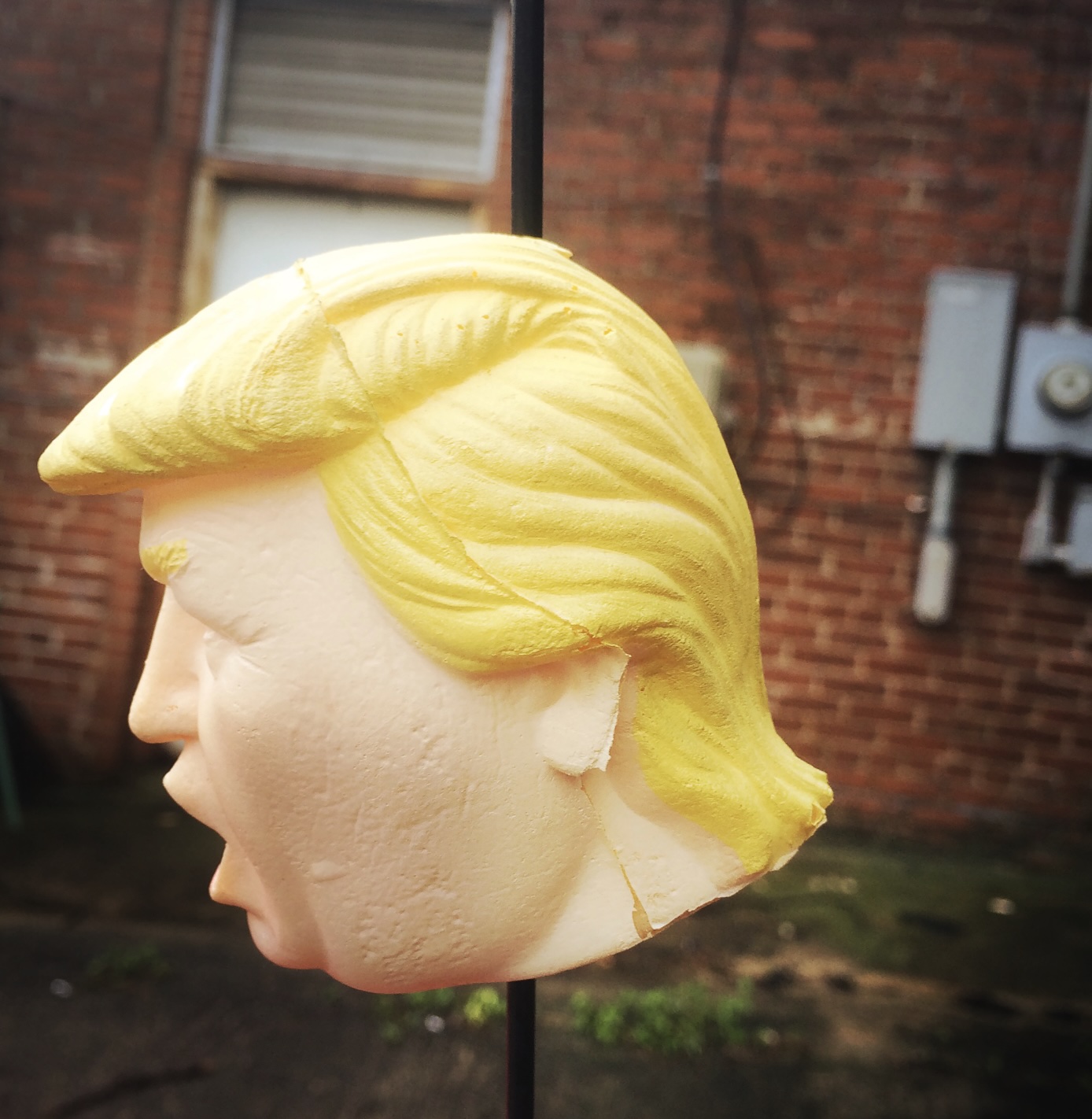
Cartoon by Drew Sheneman. "Don't Leave Any Meat on the Bone." Tribune Content Agency.Recommended Resources
Text
Anderson, Carol. One Person, No Vote: How Voter Suppression Is Destroying Our Democracy, New York: Bloomsbury Publishing, 2018.
Downs, Jim, ed. Voter Suppression in U.S. Elections. Athens: University of Georgia Press, 2020.
Berman, Ari. Give Us the Ballot: The Modern Struggle for Voting Rights in America, New York: Farrar, Straus and Giroux, 2015.
Daley, David. Antidemocratic: Inside the Far Right’s 50-Year Plot to Control American Elections. New York: Mariner Books, 2024.
Douglas, Joshua A. The Court v. The Voters: The Troubling Story of How The Supreme Court Has Undermined Voting Rights, Boston: Beacon Press, 2024.
Suitts Steve. A War of Sections: How Deep South Political Suppression Shaped Voting Rights in America, Athens: NewSouth Books, 2023.
Web
Carter, Selwyn. “Louisiana v. Callais: The Erasure of Black Political Power,” Black Politics, May 18, 2026. https://blackpolitics.org/louisiana-callais-erasure-black-political-power/.
Cohn, Nate. “The Supreme Court Case That Could Hand the House to Republicans,” New York Times, Oct. 15, 2025. https://www.nytimes.com/2025/10/15/upshot/supreme-court-voting-rights-gerrymander.html?smid=nytcore-ios-share.
Davidson, Chandler, Minority Vote Dilution, Washington: Howard University Press, 1984, Archives.org. https://archive.org/details/unset0000unse_f0s8/mode/2up.
Gersen, Jeannie Suk. “How the Supreme Court Demolished the Voting Rights Act,” New Yorker, May 2, 2026. https://www.newyorker.com/news/the-lede/how-the-supreme-court-demolished-the-voting-rights-act.
Grofman, Bernard and Chandler Davidson. Controversies in minority voting: the Voting Rights Act in perspective, Brookings Institution, 1992, OpenLibrary.org. https://openlibrary.org/books/OL1705988M/Controversies_in_minority_voting.
Kohler-Hausmann, Issa and Kevin Z. Yang. “How Callais broke the Voting Rights Act and weaponized the equal protection clause: part 1,” SCOTUSblog, May 22,2026. https://www.scotusblog.com/2026/05/how-callais-broke-the-voting-rights-act-and-weaponized-the-equal-protection-clause-part-1/.
Kousser, J. Morgan. The Shaping of Southern Politics Suffrage Restriction and the Establishment of the One-Party South, 1880-1910, New Haven: Yale University Press, 1974, Archive.org. https://archive.org/details/shapingofsouther0000kous/page/n5/mode/2up.
Suitts, Steve. “Voting Rights Act uses race merely to remedy proven racial discrimination,” Atlanta Journal-Constitution, Oct. 15, 2025. https://www.ajc.com/opinion/2025/10/voting-rights-act-uses-race-merely-to-remedy-proven-racial-discrimination/.
Similar Publications

| 1. | See Steve Suitts, A War of Sections: How Deep South Political Suppression Shaped Voting Rights in America (Athens: NewSouth Books, 2023); David J. Garrow, Protest at Selma: Martin Luther King, Jr., and the Voting Rights Act of 1965 (New Haven: Yale University Press, 1978); J. L. Chestnut, Jr and Julia Cass, Black in Selma (New York: Farrar, Straus, and Giroux, 1990); Bernard LaFayette Jr, and Kathryn Lee Johnson. In Peace and Freedom: My Journey in Selma (Lexington: University Press of Kentucky, 2013). |
|---|---|
| 2. | City of Mobile v. Bolden, 446 U.S. 55 (1980). |
| 3. | See Jo Becker and Dale Russakoff, “Proving His Mettle in the Reagan Justice Dept..” Washington Post, Jan 9, 2006; Mark Sullivan, Memorandum for Mark Levin, Dec. 12, 1985. Alito also stated he was "particularly proud of my contributions in recent cases in which the government has argued in the Supreme Court racial and ethnic quotas should not be allowed and that the Constitution does not protect a right to an abortion." |
| 4. | See Jo Becker and Dale Russakoff, “Proving His Mettle in the Reagan Justice Dept..” Washington Post, Jan 9, 2006; Mark Sullivan, Memorandum for Mark Levin, Dec. 12, 1985. Alito also stated he was "particularly proud of my contributions in recent cases in which the government has argued in the Supreme Court racial and ethnic quotas should not be allowed and that the Constitution does not protect a right to an abortion." |
| 5. | Northwest Austin Municipal Util. Dist. No. One v. Holder, 557 U.S. 193 (2009). |
| 6. | Scalia coined the term for popular consumption. See Tristin K. Green, “Rethinking Racial Entitlements: From Epithet to Theory,” 93 S. Cal. L. Rev. 217 (2020); The term “racial entitlement” was practically unused until the late 1970s. See Google Ngam Viewer: racial entitlement. |
| 7. | Allen v. Milligan, 599 U.S. ___ (2023)(Thomas, J. dissenting); Holder v. Hall, 512 U.S. 874, 892 (1994) (Thomas, J. concurring in judgment). |
| 8. | See Steve Suitts, “States' Rights Resurgent: The Attack on the Voting Rights,” Southern Spaces, Aug 29, 2013; James U. Blacksher and Lani Guinier, Lani, “Free at Last: Rejecting Equal Sovereignty and Restoring the Constitutional Right to Vote: Shelby County v. Holder,” Harvard Law and Policy Review, 8, no. 1 (2014): 39-70, where the authors write, “Shelby County is the first decision since Dred Scott to invoke the doctrine of equal sovereignty where the right to vote was involved.” |
| 9. | Cooper v. Harris, 581 U.S. 285 (2017). The Court stated that complying with the Voting Rights Act (VRA) might serve as a compelling reason to create two majority-Black districts, but the legislature failed to demonstrate that it had good cause to think that it would transgress the Act if it did not draw those race-based districts. For example, there no evidence of “racial bloc voting” by whites that would prevent Black voters from electing the candidate of their choice. |
| 10. | Richard L. Hasen. “Resurrection: Cooper v. Harris and the Transformation of Racial Gerrymandering Into A Voting Rights Tool,” American Constitution Society Supreme Court Term Review, 2016-2017, 128. |
| 11. | Abbott v. Perez, 585 U.S. 579 (2018). |
| 12. | Rucho v. Common Cause, 588 US 684 (2019). The Court was presented with a formula devised by scholars that met the standards for scientific research in other fields. It belittled the proposed test. |
| 13. | For a more detailed analysis of the Alito opinion, see Steve Suitts, “Undoing the Voting Rights Act,” Southern Spaces, July 12, 2021. |
| 14. | The case was earlier titled Merrill v. Milligan but a change in Alabama’s Secretary of State changed the case name. For a full tracking of the case, see “Milligan v. Allen (was Merrill),” at All About Redistricting. |
| 15. | Steve Suitts, “Voting Rights: Justice Alito's False, Partisan Facts,” Southern Spaces, Dec. 19, 2022. |
| 16. | Alito is disingenuous at best in his language about requiring proof of “intentional discrimination.” His opinion says it must be the “focus” of the evidence; there must be a “strong inference that intentional discrimination occurred;” and plaintiffs must “show an objective likelihood of intentional discrimination.” must present current data “that shed light on current intentional discrimination;” and must prove “an objective likelihood that the State’s challenged map was the result of intentional racial discrimination.” Also, his guidelines for proving racial discrimination turn out to be demands for proof of intentional discrimination. But Alito demurs that these requirements are not really requirements for “a finding of intentional discrimination” under §2. (See Callais, 608 U. S., at ___ (slip op., at 23,31,34-35). |
| 17. | See Stephen Ansolabehere, Bernard L. Fraga, and Brian F. Schaffner, "The Current Population Survey Voting and Registration Supplement Overstates Minority Turnout," Journal of Politics, 84, no. 3 (2022), 1850-1855; Kevin Morris and Coryn Grange, “Growing Racial Disparities in Voter Turnout, 2008–2022,” Brennan Center for Justice at New York University School of Law, March, 2024; Kevin T. Morris and Michael G. Miller. "Did Shelby County v. Holder Increase the Racial Turnout Gap?" Journal of Politics (open access, accepted December 01, 2025). Michael M. Barber and John B. Holbein, “400 Million Voting Records Show Profound Racial and Geographic Disparities in Voter Turnout in the United States,” PLoS ONE 17(6), 2022. |
| 18. | “Republicans Make Substantial House Gain,” CQ Almanac, 1980; “Democrats Win Three Gubernatorial Races,”CQ Almanac, 1983; Karl Kurtz, “NCSL Through the Decades: The 1980s,” National Conference of State Legislatures,April 30, 2025; List of Current Members of the U.S. Congress, Ballotpedia, 2026; List of Current United States Governors, Wikipedia, 2026. |
| 19. | Zoe Merriman and Alicia Bannon, “How Are State Judges Selected?” State Court Report. April 21, 2026; State Supreme Courts, Ballotpedia, 2026. |
| 20. | Alito’s opinion says §2 plaintiffs must “disentangle” race from the assumed partisan choices to win their case, but the only proven way to unravel the two under Alito’s presumptions will be for plaintiffs to produce evidence that white voters are motivated only by a discriminatory intent – proof that is virtually impossible to demonstrate in this day and age. |
| 21. | Jack Bass and Walter DeVries, The Transformation of Southern Politics ( New York: Basic Books, 1976); Dan T. Carter, From George Wallace to Newt Gingrich: The Role of Race in the Counterrevolution, 1963-1994 (Baton Rouge: Louisiana State University Press, 19960; Earl Black and Merle Black, The Rise of Southern Republicans (Cambridge, MA: Belknap Press, 2002); David Lublin, The Republican South: Democratization and Partisan Change (Princeton: Princeton University Press, 2004); Mary V. Hood III, Quentin Kidd, and Irwin L. Morris, The Rational Southerner: Black Mobilization, Republican Growth, and the Partisan Transformation of the American South (New York: Oxford University Press, 2012); Seth C. McKee, “Party Affiliation in the Southern Electorate,” Political Research Quarterly, 2024, Vol. 77(1) 432–446. |
| 22. | J. Morgan Kousser, “The Immutability of Categories and the Reshaping of Southern Politics,” Annual Review of Political Science, vol. 13, no. 1 (2010): 365-383; Hood et. al, The Rational Southerner, 181. See also Ilyana Kuziemko and Ebonya Washington, “Why Did the Democrats Lose the South? Bringing New Data to an Old Debate,” American Economic Review vol. 108, no. 10, 2018, 2830–2867 and Christopher A. Cooper, M. V. Hood III, Scott Huffmon, Quentin Kidd, H. Gibbs Knotts & Seth C. McKee, “Switching Sides but still Fighting the Civil War in Southern Politics,” Politics, Groups, and Identities, vol. 10, no. 1. 2022, 100-116. |
| 23. | Lublin, The Republican South, 222; Robert N. Lupton and Seth C. McKee, “Dixie’s Drivers: Core Values and the Southern Republican Realignment,” Journal of Politics, vol. 82, no. 3, May 2020, 932; Joshua N. Zingher, Polarization, Demographic Change, and White Flight from the Democratic Party,” Journal of Politics, vol. 80, no. 3, AApril2018, 866; Byron E. Shafer and Richard Johnston. The End of Southern Exceptionalism: Class, Race and Partisan Change in the Postwar South (Cambridge: Harvard University Press, 2006), 136-138. See Kousser, “The Immutability of Categories and the Reshaping of Southern Politics,” 374-377, for an assessment of these studies and others. |
| 24. | Shiro Kuriwaki, , Stephen Ansolabehere, Angelo Dagonel, and Soichiro Yamauchi, “The Geography of Racially Polarized Voting: Calibrating Surveys at the District Level,” American Political Science Review, vol. 118, no. 2, 2024, 922-939; Issa Kohler-Hausmann and Kevin Z. Yang, “How Callais Broke the Voting Rights Act and Weaponized the Equal Protection Clause: Part 1,” SCOTUSblog.com, May 26, 2026; David Lublin, Lisa Handley, Thomas L. Brunell, and Bernard Grofman, “Minority Success in Non-Majority Minority Districts: Finding the ‘Sweet Spot,’” Journal of Race, Ethnicity, and Politics, Vol. 5, no. 2, 2020, 275-298. |
| 25. | Some voting rights scholars have been sympathetic to the Court’s insistence that party and race need to be disentangled for §2 cases. See, for example, Richard L. Hasen, “Race or Party, Race as Party, or Party All the Time: Three Uneasy Approaches To Conjoined Polarization In Redistricting and Voting Cases,” Willian and Mary Law Review, Vol. 59, 2017, 1837-1885. But the Court majority misunderstands the social construction and nature of race and racism, as if race is only a reflection of person’s skin color disentangled from who they are, their collective history in a given place, what they represent, what they believe and who they support. |
| 26. | The social science methods for disentangling race to determine that it is a singular motive entirely separate from party where the two correlate in voting in a state or Congressional district (with over 500,000 people nowadays) present problems that have not yet been tackled and probably never will be to the satisfaction of the current Court. They are far greater than the challenges that Morgan Kousser explored earlier in how judges and researchers assemble the “factors that ought to be taken into account in any inquiry into the intent with which an electoral rule was adopted or maintained.” See Morgan Kousser, “Intent and Effect in Law and History,” Colorblind Injustice: Minority Voting Rights and the Undoing of the Second Reconstruction (Chapel Hill: University of North Carolina Press, 1999), 346-366. |
| 27. | Emphasis added. Voting Rights Act Extension, Report of the Committee on the Judiciary, Unites States Senate, on S. 1992, 97th Congress, May 25, 1982, 67. This unmistakable record explains why for forty years the Supreme Court did not under the Gingles decision require any evidence of discriminatory intent or purpose. |
| 28. | Allen v. Milligan, 143 S. Ct. 1487 (2023); “Alabama Second Congressional District Election Results,” New York Times, Nov. 27, 2024. |
| 29. | Allen v. Milligan, 608 U. S. ____ (2026). |