
Overview
"The Rise of Black Political Power" traces Atlanta's political transformation from the 1940s through the 1970s, as sustained voter registration and organizing shifted Black Atlantans from "being the balance of power to being the power." Highlights include the historic elections of Leroy Johnson and Maynard Jackson, and Julian Bond's fight to take his seat in the Georgia legislature after lawmakers refused to seat him because of his support for a SNCC statement condemning the Vietnam War. "The Rise of Black Political Power" is the fifth installment in Southern Spaces's Trouble the Land series as well as the series's final presentation featuring Atlanta.
Trouble the Land: A Personal History of the Civil Rights Movement in Five Southern Cities is a series of multi-media presentations exploring the local character of the civil rights movement through the voices of those who lived it. The series, which covers Atlanta, GA, Montgomery, AL, Columbia, SC, Jackson, MS, and Little Rock, AR, is a transformation of the 1997 Peabody Award-winning audio documentary Will the Circle Be Unbroken? produced by the Southern Regional Council (SRC) and distributed by Public Radio International (PRI). Trouble the Land pairs Will the Circle Be Unbroken's audio (without popular music excerpts) with an enhanced transcript featuring curated photographs, video, archival images, original maps, informational text links, and recommended resources. Through Trouble the Land, Southern Spaces seeks to stimulate critical discussion about the civil rights movement and the process of societal transformation among scholars, activists, educators, students, and the general public.
The Rise of Black Political Power
Maynard Jackson: I ran because I became convinced after King was shot and killed, and Martin Luther King was one of the great heroes of my life, that politics is not perfect, but it's the best available nonviolent means of changing how we live. If we don't like how we live, we can participate in the most perfect revolutionary act in a democracy. And it's called voting.
(0:27) Vertamae Smart-Grosvenor (Narrator): In 1973 Maynard Jackson was elected mayor of Atlanta, Georgia. He would become the first Black to run a large city in the American South. Jackson's victory signaled a new era in a city where whites had always placed "business over politics."


Jesse Hill Jr.: Historically, the white business leadership usually calls us in for a meeting to see if we can get together and who would be the best mayoral candidate. This time we called the meeting.
We called the meeting and told them we had a candidate, who was Maynard Jackson, and they were a little shocked. But we had the votes, and we were together, and nothing they could do to divide us.
Lonnie King: So we had moved from being the balance of power to being the power.
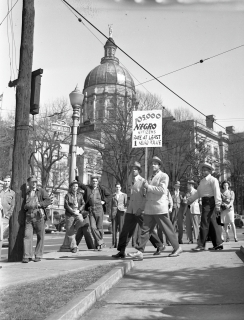
(1:15) Narrator: Jackson's election was built upon decades of political organizing among Black Atlantans. In the late 1940s, block-by-block voter registration led to the formation of the Atlanta Negro Voters League.
Rev. William Holmes Borders: I remember during the early years, the Negro vote was split right down the middle, with Dobbs leading one group and Walden leading the other, and our candidate lost. So that instead of splitting, we came together in the Atlanta Voters League, and let it be known that it was non-partisan. And we supported the best candidate for the position without reference to the Democratic or the Republican Party.1WRFG-FM/"Living Atlanta" Collection, Atlanta History Center, Atlanta, GA.
(2:03) Narrator: In the 1950s and early 1960s, the Voters League proved crucial in electing racial moderates and keeping white extremists out of office.
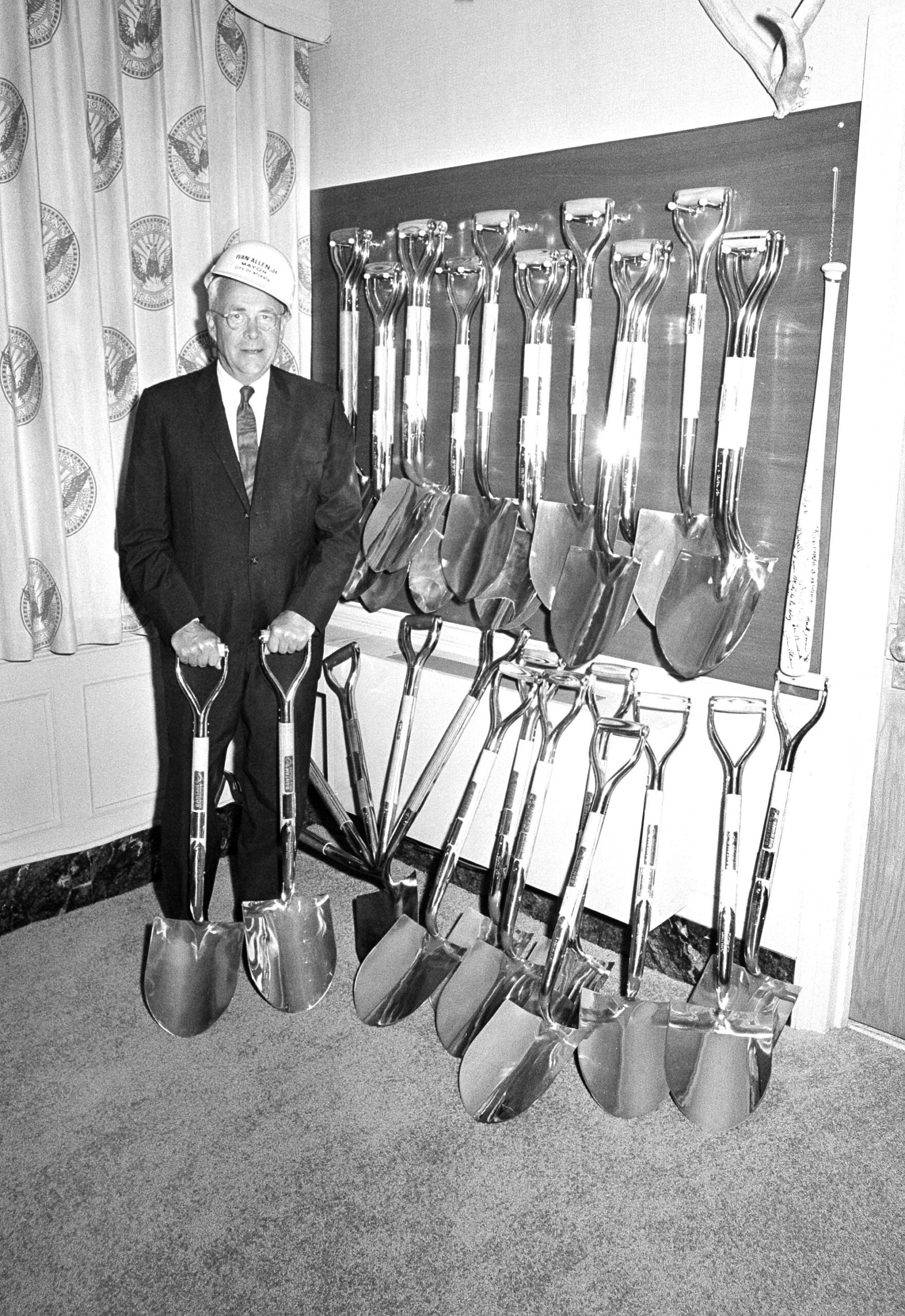
Ivan Allen Jr.: You have had to tie together the moderate white with the Negro vote in order to sustain liberal or fair policies. Those who have appealed only to racial prejudice have usually ended up with about half of the white vote and defeated.2Ralph J. Bunche Oral History Collection, Moorland-Spingarn Research Center, Howard University, Washington, DC.
Jesse Hill Jr.: Mayor Hartsfield and Ivan Allen, of course, owe their election to Black voters. In fact, consistently the overall majority of white voters voted for the opponents of Hartsfield and the opponents of Allen. Lester Maddox would have been mayor if Blacks did not have the vote. It was crucial to the progressive growth and development of Atlanta.

(2:58) Narrator: After federal courts and the US Congress struck down the all-white primary, literacy tests, and other methods used to suppress Black voting, voter registration became a key strategy. In the 1960s, after sitting-in at segregated facilities, Atlanta students turned their attention to the ballot box.
Student leader Lonnie King:
Lonnie King: In 1960 we registered five thousand people in the thirty-day period, the students did. I mean we went out and got 'em and registered them. So the voting population had moved from about seventeen thousand people to over twenty, over thirty. So we had numbers by that time.
Jesse Hill Jr.: We had 35 percent of the vote, and 65 percent was white.
(3:47) Narrator: The new votes meant Blacks could do more than supply the balance of power to elect white moderates. Now there were opportunities to elect Black candidates to public office. In 1962 court-ordered reapportionment of the Georgia State Senate, long dominated by rural white politicians, opened the door for Atlanta attorney Leroy Johnson.
Rev. Hosea Williams: Leroy Johnson, he was kind of like the political spokesman of the Black community, and he was kind of like the political leader. And he got himself elected to the Georgia seat—the first Black elected in the South to a state legislature since Reconstruction. This boy got himself elected to the State Senate.
(4:33) Narrator: Johnson's reception in the State Capitol was lacking the traditional southern hospitality.
Leroy Johnson: When I first went to the Senate, there were fifty-six members of the Senate, and only five spoke to me my first session there. The others would say, "Mmmm." I would walk down the corridors and say, "Good morning, Senator." And they'd say, "Mmmm." But never, "Good morning. How are you?" You know?
(4:57) Narrator: For most whites in 1962, eating with a Black person in a restaurant was still unacceptable. Leroy Johnson recalls his first visit to the State Capitol's cafeteria.
Leroy Johnson: We went through the line, picked up our food on the tray, made our selection and got to the place where we were to pay for the food, to the cashier. And she looked up and saw me, she says, "Oh, no. No. Uh, we can't accept your money." So I said, "What do you mean?" She said, "Wait just a minute. Wait just a minute."

So she gets up, and I guess she goes and gets her supervisor. So, the supervisor come, and she gets to the counter. She says, "What's the problem?" She says, "Well, he wants to come through." And the supervisor looked at me [chuckles] and looked at Joe Salome, and Joe Salome said, "This is Senator Johnson. And I'm Senator Salome." And so, the man told the lady on the cash register, said, "Let 'em through! Let 'em through! They're senators! They're senators! Let 'em through."
So we went on, and we walked through, paid her, and I had my tray. Tables were full of people. We're looking and say, "Oh there's a couple of seats there." So I took my tray, and Joe was behind me. I walked over to the table, put the tray down.
And as I put the tray down, every person who was sitting at the table got up. As I put the tray down to sit down, they picked their tray up and got up. And they left and went to another table. So [laughs] Joe came and sat down, and he turned around and said to me, said, "Leroy," said, "you’re the greatest thing since Metrecal."
The State Capitol cafeteria was desegregated as a result.
(6:42) Narrator: Further reapportionment in 1965 enabled more Black candidates to run for office. Organizers from SNCC—the Student Nonviolent Coordinating Committee—saw an opportunity. They approached their colleague Julian Bond to run for the Georgia House of Representatives.
Ivanhoe Donaldson: We talked Julian into running, basically is what it came down to. I think, this was the farthest thing from Julian's mind. It was probably the farthest thing from anybody at SNCC's mind. And we took this to SNCC as a project. They gave us five hundred dollars and told us to go back to Atlanta and organize a campaign. You know, and this is in 1965. Five hundred dollars. We said, "No problem."
We rented a desk in the front window of a wig shop on Hunter Street, and that was the campaign office. We had a phone line, desk in there, "Vote Julian Bond," and we went about organizing in the community to win this seat [chuckling].
Charlie Cobb: We ran the campaign the way we ran organizing in Mississippi. So it involved knocking on doors, sitting down, talking to people and, perhaps more importantly, listening to people.

Charles Black: I worked with Julian in that campaign. A lesson that all politicians should learn, in Julian's very first campaign, the way he politicked was exemplary. What we did was to visit the homes of people all over the district, and ask them questions, rather than having them ask him questions. You know, "What are your problems?" You know? "What would you like to see changed?" And made a record of all it. You know?
And people were talking about the potholes and the lack of streetlights, garbage collection, whatever. Whether it was a state matter or not, it didn't matter. And what Julian did during the course of his campaign was to respond to these problems. You know, he would call the appropriate authorities and got things done while he was running for office. You know? Which I thought was beautiful.
Ivanhoe Donaldson: Julian was married and had some kids, and his wife at the time never was really quite happy about this campaign concept. So a lot of times, she would leave Julian stuck with the kids at home. So Julian couldn't come out and campaign. We just told people that Charlie Cobb was Julian Bond. And Charlie would knock on doors, introduce himself as Julian Bond and people would say "fine," and we just rolled right along!
James Forman: Julian, you know, ran as a SNCC candidate, believe it or not. I mean, he ran as a candidate of the Student Nonviolent Coordinating Committee, and he was elected as a candidate. And even in his appeal he made it very clear that he was a candidate of the Student Nonviolent Coordinating Committee. He was opposed to the war in Vietnam, and he was still elected.
(9:29) Narrator: The Georgia House of Representatives, seeking any excuse to exclude a civil rights activist, refused to seat Bond because he supported a SNCC statement strongly condemning the Vietnam War.
Julian Bond: I was refused my seat because the organization for which I worked at the time, the Student Nonviolent Coordinating Committee, issued a statement critical of the war in Vietnam, critical of the draft. If I'd been white and worked for the YMCA, I never would have had this trouble at all, no way in the world. They would have said, "Well the guy's a pacifist. We understand."3"Dawn's Early Light," Ralph McGill Papers, Stuart A. Rose Manuscript, Archives, and Rare Book Library, Emory University, Atlanta, GA.

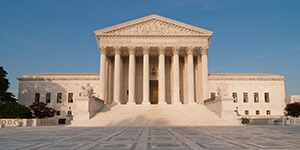
Ivanhoe Donaldson: The case went all the way to the Supreme Court. They ordered the Georgia House to seat Julian.
(10:05) Narrator: Julian Bond's election demonstrated the independence of Atlanta's Black voters. But white flight and Black in-migration would set in motion even greater political change. By 1969 Blacks made up roughly half the city's population and 41 percent of Atlanta's registered voters.
Dan Sweat: Well, there was a big change in demographics. Yes, because you had, I mean a lot of Blacks moved into this city over that period of time.
Sam Massell: Whites moved out because of this fear of what was happening with integration. And so I think both is what caused a big shift in the numbers.
Dan Sweat: Atlanta started emerging as an economic base, and the door was beginning to be opened. And of course the influence of the Atlanta University schools there, which drew a lot of some of the brightest young Blacks from throughout this country, throughout the world, into the city because of that. And, and then, some of them began to stay here and get into positions of power, and you begin to see the development of a Black business community, a Black middle class.
Jondelle Johnson: Blacks all over the world started looking at Atlanta, ya know, like, like a haven. This is the place to be—a Mecca.
Dan Sweat: Numbers changed. And Blacks began to feel comfortable about voting. And through the voter registration, whole voter registration movement, I think it was a matter of finally numbers.
Jesse Hill Jr.: We convinced the chief registrar to give us a deputy-registrar. There was one time we had to go all the way to the courthouse. We were able to persuade him to deputize registrars. And we had registrars in our community. And we used to have registration in shopping centers, but it made registration very accessible.

(12:04) Narrator: While there were significant changes in the political process, some things remained the same.
Sam Massell: There was enough prejudice where, you know, they would say, "Well, okay, let them dine with us, but they're not going to marry my daughter." "Okay, we'll elect them to city council but not to the mayorship." So it wasn't until they got a majority that they were able to elect one to the mayor.
(12:31) Narrator: In 1968, thirty-year-old attorney, Maynard Jackson, did the unthinkable. He challenged US Senator Herman Talmadge in the Democratic primary. Surprisingly, he carried Atlanta. And the next year, against the advice of the city's older Black leadership, Jackson was elected vice-mayor.
Maynard Jackson: Somebody had to break out of the pack. Somebody who was not going to footsy around with these people whose morality was occasional and who were fighting against Black equality, equal rights for Black people, and I saw myself as one of those people.
(13:14) Narrator: Between 1970 and 1972, Black voter registration continued to increase, while whites left for the suburbs. The shifting numbers set the stage for the next mayoral election.
Maynard Jackson: I had reasonable expectation of winning, and I also knew that I could beat Sam Massell because most of his vote was my vote.
(13:35) Narrator: In 1973 Maynard Jackson announced his candidacy for mayor.

Activist Shirley Franklin:
Shirley Franklin: And Maynard did not ask for permission to run for office, from the old guard. And the old guard thought that someone who had paid more dues than he had paid should run and win.
Maynard Jackson: I was still viewed as kind of an interloper, an upstart, young Turk.
Shirley Franklin: So there was a struggle within the African American community as to who would assume the mantle of power.
(14:08) Narrator: It was a struggle that Jackson would win.
Dan Sweat: I think that might have been one of the very key turning points in this city, that the old leaders realized that there had to be some compromise, that the door had to be opened for some of the young leaders who didn't necessarily think just like them or act just like them, and perhaps weren't as willing to compromise as easily as some of the older heads had been willing to do.
(14:36) Narrator: With unified Black support, Jackson nearly won the primary outright. He faced incumbent mayor Sam Massell in the runoff. Appealing to white fears, Massell adopted a new campaign slogan.
Maynard Jackson: Sam Massell made it easier for me by saying, "Atlanta was too young to die." This kind of racial implication campaign he was running, showing on TV like an abandoned Western mining town, with tumbleweed blowing through the streets and boarded-up fronts. I mean this was on TV, right?
Shirley Franklin: The implication meant that the city would not continue to grow and thrive if Blacks were in political power. I remember how startled I was that a white running for office in Atlanta would be so bold as to suggest that the city would die under Black leadership. It's something you'll never forget.
Ronald Bayor: That brought out the Black vote.

Maynard Jackson: The election itself was a movement.
Shirley Franklin: I went looking for the campaign. I was very anxious to be involved. Lots of young people were. I put stickers on, bumper stickers on cars and registered people to vote and did leafletting. I moved up to doing fundraising, which I like to do. Pressing the flesh. I think it was a very optimistic time.
TV News Report: WSB News. Time, 7:30. Good evening, everyone, from the Atlanta, Georgia, Civic Center. This is the People's Inaugural where soon Maynard Jackson will be sworn in as the forty-seventh mayor of Atlanta, and here at the Civic Center there is a capacity crowd and more, about five or six thousand people who await the swearing in.4WSB Television News Video Archives, Walter J. Brown Media Archives & Peabody Awards Collection, University of Georgia, Athens, GA.
(16:12) Narrator: On a November night in 1973, Maynard Jackson, grandson of voting rights pioneer John Wesley Dobbs, became the urban South's first Black mayor.
Alice Holmes Washington: We felt the way we used to feel years and years and years ago when Joe Louis would fight and win. It was that sort of exuberance. When Joe Louis would fight and people run out into the streets as soon as the last knockout was counted. You could tell what was happening because of the noise in the street. You knew that this house had it on the radio, and that and the other. And that's the way, little clusters of people, felt the pride.
Jondelle Johnson: But the white power structure never did accept Maynard. They were still trying to run everything, you see, and giving him a hard time because he wouldn't just go along with their little perception that they were trying to perpetuate. You know, that this was a city where we all got along.
(17:23) Narrator: Maynard Jackson won 90 percent of the city's Black vote, 17 percent of the white. For the first time, the mayor was not the choice of Atlanta's white power structure.
Maynard Jackson: What I had to go through as the brand-new mayor of Atlanta starting January 7th of 1974 and what Mandela is facing in South Africa are somewhat similar. Of course, Atlanta on a much, much smaller scale, right? Exaggerated Black expectations and exaggerated white anxieties.
Shirley Franklin: The white power structure was shocked. I mean, he was seen as a radical. Talking about radical things. I mean, "What is this thing called 'inclusion'? What do you mean? We've, you know, we've always had African Americans at the table." I mean, "What is this 'community empowerment'?"
Dan Sweat: I think Maynard was probably almost the perfect Black person to be mayor in that transition. I think it took somebody like Maynard to sort of rub, rub salt in the wounds of the, of the people in the white community who had been resisting. And, and he did a lot of that.

(18:40) Narrator: Historian Ronald Bayor:
Ronald Bayor: There's a rebellion from the white community. They feel they're losing power at City Hall. They feel like their decisions aren't going to be accepted anymore. They begin to accuse Jackson of anti-white, being anti-white, which he certainly wasn't. They accused him of destroying Atlanta and emptying out downtown of businesses.
Shirley Franklin: But Maynard basically said, "Black people are gonna be at the table, and we're gonna be at the table not just on your terms. We're gonna be there on our terms as well." And he represented our interests.
Maynard Jackson: Now, the power structure hated it. I still have the scars on my back to prove it. You don't have enough time or enough tape for me to tell you all the stories.
Shirley Franklin: He stood his ground, when many of us would have fallen by the wayside. He never buckled. He was resolute.
(19:30) Narrator: Dan Sweat was the Director of Central Atlanta Progress, an organization representing the city's downtown business interests.
Dan Sweat: I remember one thing I told him when he first came in. He, uh, there were articles in the paper about lack of communication between Maynard and the business community, and he was quoted in the article one morning, and he said, "That's not true, I have communications with the business community. I talk to Dan Sweat nearly every day."
Well, I called him. I went over to see him. I said, "Maynard, let me suggest something." I said, "Now, you made this statement and," I said, "it is true, sometimes you and I shout at each other when we're talkin', but we do talk, and I appreciate it, we need to, but you need to talk directly to the CEOs." And I said, "I'll tell you what I'll do." You'd be surprised. I said, "I'll come over here every day—you tell me when. I'll have a list of CEOs that you call, and I'll even suggest what you ask 'em to do. I'll dial the phone for you and hold it to your mouth, and you call 'em and say 'This is your mayor, Maynard Holbrook Jackson Jr., and I need your help. And would you do so and so?'"
I said, "You know nine out of ten of 'em will say, 'Yes, sir, Mr. Mayor, I'll do it.'" I said, "I know 'em." I said, "Now, that tenth one will have a heart attack and drop dead on the spot [laughs] but, but, they'll do it."


(21:00) Narrator: Jackson's administration unleashed the power of local government to help solve Atlanta's problems.
Shirley Franklin remembers the administration's energy and efforts.
Shirley Franklin: I mean, you know, literally hundreds of initiatives. Everything from neighborhood planning base, I mean, letting people who live, regardless of who you are, input into the city's planning system. To the minority and female business initiatives. To building Hartsfield, building a first-class airport but including African Americans and women in that process.
Maynard Jackson: I am still amazed today at how much we influenced America with lighting the candle here in Atlanta on affirmative action.
Shirley Franklin: I mean, I think in large part, the Olympics coming here had a lot to do with the groundwork that he laid.
(21:48) Narrator: While the vestiges of segregation began to crumble during Jackson's two terms as mayor, new problems came into focus. Atlanta inherited the problems of urban America. Today the city is one of the nation's poorest.

Ethel Matthews: You can go eat anywhere you want to eat if you've got the price. You can go to any hotel and stay if you've got the price. And a lot of us, reason we don't go to restaurants and eat, and reason we don't go take vacations, reason we don't stay in hotel—we don't have the money.
Rev. Austin Ford: And what we see here is people just falling apart on almost an hourly basis. I think one of the most alarming things is the growing disaffection of poor Blacks for rich Blacks.
Gene Ferguson: The poor community feel and believe that it have been abandoned both by middle-class Blacks and by the white community as a body, and they left alone. In Atlanta, I mean, we're the second poorest city that there is. I mean now we got a 95 percent Black segregated school system—and poor. And yet, that we still have this image of a city that causes us sometime to try to pretend that Atlanta still is this great city.
Maynard Jackson: We are a nation of cities. Sixty percent of African Americans live in cities. Take Black poverty as an example. If you don't have an urban policy, you are not going to solve crime or poverty. There is no comprehensive, national urban policy. Period. There's no road map. If you don't have a road map of how to go from point A to point B, you're liable to wander in the desert. And that's what we're doing now. 
About the Creators
The audio documentary series Will the Circle Be Unbroken? was produced by the Southern Regional Council (SRC) and distributed by Public Radio International (PRI). George King served as producer, Steve Suitts as executive producer, and Worth Long and Randall Williams were senior associate producers. The series was narrated by Vertamae Smart-Grosvenor. The episode "The Rise of Black Political Power" was written by George King, Steve Suitts, and Cliff Kuhn with Vertamae Smart-Grosvenor.
Trouble the Land is adapted and developed from the Will the Circle Be Unbroken? radio programs by the staff of Southern Spaces and the Emory Center for Digital Scholarship. Ella Myer serves as series editor. Audio and video editing by Steve Bransford. Additional editing by Allen Tullos, Angelica Johnson, Ayoung Kim, Nyaradzai Mahachi, and Jessica Halsey. Inquiries about the series can be directed to seditor@emory.edu.
Banner image: Maynard Jackson casts his vote as a group of children look on, Atlanta, Georgia, 1973. Photograph by Ron Sherman.© Courtesy of Ron Sherman Papers, Stuart A. Rose Manuscript, Archives, and Rare Book Library, Emory University.
Recommended Resources
Archival Materials
To access a digitized selection of the unedited oral histories that the Southern Regional Council conducted and used as the foundation for the Atlanta episodes of Will the Circle Be Unbroken? visit Emory University's Aviary Digital Archive.
Will the Circle Be Unbroken's physical program files and sound recordings can be found in the Stuart A. Rose Manuscript, Archives, and Rare Book Library at Emory University.
Bacote, Charles A. "The Negro in Atlanta Politics." Phylon 16, no. 4 (1955): 333–50.
Bayor, Ronald H. Race and the Shaping of Twentieth Century Atlanta. University of North Carolina Press, 1996.
Brown-Nagin, Tomiko. Courage to Dissent: Atlanta and the Long History of the Civil Rights Movement. Oxford University Press, 2012.
Grady-Willis, Winston A. Challenging U.S. Apartheid: Atlanta and Black Struggles for Human Rights, 1960–1977. Duke University Press, 2006.
Hobson, Maurice J. The Legend of the Black Mecca: Politics and Class in the Making of Modern Atlanta. The University of North Carolina Press, 2017.
Hornsby, Alton. Black Power in Dixie : A Political History of African Americans in Atlanta. University Press of Florida, 2009.
Jones, Mack H. "Black Political Empowerment in Atlanta: Myth and Reality." In Knowledge, Power, and Black Politics: Collected Essays. State University of New York Press, 2014.
Pomerantz, Gary M. Where Peachtree Meets Sweet Auburn: A Saga of Race and Family. Penguin Books, 1996.
Tuck, Stephen G. N. Beyond Atlanta: The Struggle for Racial Equality in Georgia, 1940–1980. University of Georgia Press, 2003.
Walker, Jack. "Negro Voting in Atlanta: 1953–1961." Phylon 24, no. 4 (1963): 379–387.
Web
Atlanta History Center. "The Color-Line: Problem of the Centuries." Accessed September 14, 2026. https://www.atlantahistorycenter.com/exhibitions/the-color-line-the-problem-of-the-centuries/.
Atlanta University Center. "Seeking to Tell a Story: Political Action from Slavery to Civil Rights." Accessed September 14, 2026. https://digitalexhibits.auctr.edu/exhibits/show/seekingtotell/overview.
Davies, Tom Adam. "Ethel Mae Matthews and the Emmaus House in Atlanta." African American Intellectual History Society, September 11, 2017. https://www.aaihs.org/ethel-mae-matthews-and-the-emmaus-house-in-atlanta/.
Lands, LeeAnn. "Emmaus House and Atlanta’s Anti-Poverty Movements." Atlanta Studies, April 28, 2015. https://atlantastudies.org/2015/04/28/emmaus-house-and-atlantas-anti-poverty-movements/.
Similar Publications
| 1. | WRFG-FM/"Living Atlanta" Collection, Atlanta History Center, Atlanta, GA. |
|---|---|
| 2. | Ralph J. Bunche Oral History Collection, Moorland-Spingarn Research Center, Howard University, Washington, DC. |
| 3. | "Dawn's Early Light," Ralph McGill Papers, Stuart A. Rose Manuscript, Archives, and Rare Book Library, Emory University, Atlanta, GA. |
| 4. | WSB Television News Video Archives, Walter J. Brown Media Archives & Peabody Awards Collection, University of Georgia, Athens, GA. |