Overview
With an emphasis on 1960, "Atlanta Student Movement" explores the origins and tactics of student-led civil rights activism in Atlanta, Georgia, through the voices of participants. Topics include the publication of "An Appeal for Human Rights," the boycott of Rich's Department Store, and the tensions between student activists and older members of Atlanta's Black power structure."Atlanta Student Movement" is the second installment in Southern Spaces’s Trouble the Land series as well as the second of the series' five presentations featuring Atlanta.
About the Series
Trouble the Land: A Personal History of the Civil Rights Movement in Five Southern Cities is a series of multi-media presentations exploring the local character of the civil rights movement through the voices of those who lived it. The series, which covers Atlanta, GA, Montgomery, AL, Columbia, SC, Jackson, MS, and Little Rock, AR, is a transformation of the 1997 Peabody Award-winning audio documentary Will the Circle Be Unbroken? produced by the Southern Regional Council (SRC) and distributed by Public Radio International (PRI). Trouble the Land pairs Will the Circle Be Unbroken's audio (without popular music excerpts) with an enhanced transcript featuring curated photographs, video, archival images, original maps, informational text links, and recommended resources. Through Trouble the Land, Southern Spaces seeks to stimulate critical discussion about the civil rights movement and the process of societal transformation among scholars, activists, educators, students, and the general public.
Click for audio
Atlanta Student Movement
Andrew Young: The leaders in that period were not the mayor, not the president; it was four college freshmen that started the sit-in movement, see? It was actually high school kids who got upset because their parents couldn't register to vote that got the Voting Rights Act, see? And so in all of my lifetime, social change has come from the young while they were in school, see?
(0:29) Vertamae Smart-Grosvenor (Narrator): During The 1940's and '50's, the Atlanta style emerged as the city's response to racial conflict. Accommodation and compromise guided the approach of the city's leaders—Black and white. Warren Cochrane was a member of the small group of ministers, academics, business and professional men who made up Atlanta's Black leadership.
Warren Cochrane: Now, we didn't have strength enough or voting power enough to elect anybody in those days. And what we had to do was use whatever strategy we could. We worked with the business community because they wanted the best leadership we could get. They did not want rabble-rousers. Our job was to keep the rabble-rousers out.

(1:14) Narrator: Following the victory of democracy in World War II, and the historic 1954 Supreme Court decision outlawing segregation, no small group of men—of any color—could manage the forces of racial change. A new, younger generation would challenge the Atlanta style.
Mary Ann Smith Wilson: Each college student at that time, especially Black college students, brought with them a peculiar kind of history that made everything gel, you know, two or three years later.
Julian Bond: There was this accumulation of things that pushed on the minds of young people, young Black people in 1960.
(1:52) Narrator: Young Black American students coming of age at the end of the fifties had grown up in a period of rising expectations. They had witnessed the Montgomery bus boycott on TV and followed the efforts of Little Rock students in the pages of Jet magazine. In 1960, Julian Bond was a student at Morehouse College in Atlanta.
Julian Bond: They had these Little Rock kids who were our peers, and they were so brave and so courageous, that you couldn’t help but say, "Gee, I hope if I’m ever tested in this way, I can behave the same way."
Our classmates included African students, who were so smug in their condemnation of our inaction. They’d say, "Listen, we’re freeing our nations. We’re leading revolutions. We’re escaping the yoke of colonialism. All of Africa will be free before you people can drink a cup of coffee." And you know that hurt, that hurt.
(2:51) Narrator: Student Morris Dillard:
Morris Dillard: The pain had reached a point where all you needed was a spark, in the form of a tool—a mechanism through which you could protest. And of course that was provided by the sit-in movement in North Carolina, Greensboro.
(3:12) Narrator: On February 1, 1960, four Black college students startled the nation when they sat in at a segregated lunch counter in Greensboro, North Carolina. By April, thousands of young people were sitting-in across the south.
Julian Bond: It had happened other places before, and they never caught on, they never spread. Why did it catch on when it happened in Greensboro? It may have been that the Associated Press and United Press broadcast fairly neutral descriptions of what was happening. And any newspaper reader could pick that up and say, "Oh, this is how you do it." It’s like an instruction manual.
(3:50) Narrator: Atlanta students took note of this new strategy, where young, committed activists would simply sit-in at segregated facilities, refusing to leave when they were denied service because of their race. Direct and confrontational as a tactic, it was a radical departure from the Atlanta tradition of quiet compromise and private negotiations.
Morehouse college students Julian Bond and Lonnie King recall how Atlanta’s new era of public protest began:
Lonnie King: On the second of February 1960, I was talking to one of my best friends at the time, a guy named Joseph Pierce. We were reading the paper, and I was talking about what happened up in Greensboro.
Julian Bond: I was in Yates and Milton’s Drug Store one day, which was a campus hang-out, killing time between classes, smoking and drinking coffee. And a fellow came up to me, and I didn’t know him well at all. He showed me a newspaper headline from the Atlanta Daily World. It said "Greensboro students sit in for third day."

Lonnie King: I said "Julian, you see this newspaper and have you read it?"
Julian Bond: He said, "Don’t you think it ought to happen here?" I said, "I’m sure it will."
Lonnie King: I says, "I think we need to make it happen and I’d like to have you help us."
Julian Bond: I said, "What do you mean, we?" He said, "You take this side of the drug store, and I’ll take the other side, and we’ll put together a little meeting of students."
(Background noise of student meeting)
(5:19) Narrator: At the meeting, the students decided to involve all six of Atlanta’s Black colleges in the effort. The college presidents soon got word of things and encouraged the student leaders to draft a list of their grievances.
Student leader Mary Ann Smith:
Mary Ann Smith Wilson: We were very attentive to what the presidents had to say. They said that we would sponsor it, pay for it, you know. You students write it, express your grievances in writing, expose it to the world, well through the Atlanta Journal and Constitution, and we’ll pay for it. And maybe we can initiate some activity this way. Some across-the-table type meetings, negotiations, and what have you.

Julian Bond: Well, this very first statement we put in the paper, the "Appeal for Human Rights," listed a long list of grievances, police protection, the extension of city services, parks, and things like that. So from the very first, there was this sense that this was about more than lunch counters.
Lonnie King: We published it on about the twelfth of March 1960 where we set forward certain things.
Excerpt from "An Appeal for Human Rights:" "We want to state clearly and unequivocally that we cannot tolerate in a nation professing democracy and among people professing Christianity, the discriminating conditions under which the Negro is living today in Atlanta, Georgia—supposedly one of the most progressive cities in the South."
Julian Bond: It caused a shock wave to go through the Atlanta community when it was published. Governor Vandiver (who was famous as, No-Not-One-Vandiver "Not-one-Black-child-will-ever-enter-a- Georgia-public-school-while-I’m-governor, Vandiver") said, "This sounds as if it had been written in Moscow, if not in Peking."
Ernest Vandiver: That statement was skillfully prepared. Obviously, it was not written by students. Regrettably, it had the same overtones which are usually found in anti-American propaganda pieces.
Mary Ann Smith Wilson: Well, all of a sudden you, I won’t say celebrity, but because it was published in the New York Times, I think. New York Times. Letters came in from student governments all over the country.
(7:32) Narrator: Atlanta University's college presidents—part of the older Black leadership—were caught in a dilemma. While it was difficult to argue with the students' demands, endorsing them would jeopardize the Atlanta style of private negotiation and threaten the power of the older leaders in the community.
Lonnie King: They saw themselves being replaced. That I think caused a great deal of problem. You had the old guard Black leadership who were upset about these young upstarts who were coming in here threatening to make gains in a year or less that they had been working on as they saw it for 30 or 40 years. Then, of course, the whites who were in power didn't want to give up anything without you just taking it from them.
(8:30) Narrator: But the students would not be quieted, and they had their own sense of style.
Julian Bond: Part of what we wanted to do was to demonstrate that Atlanta students were going to be the best organized, the most disciplined, because this was then the largest collection of Black college students in America.
Mary Ann Smith Wilson: Each student leader from the various campuses would go and sort of pick students that would go to represent your college, who wanted to participate. That's the way the first one was done.
Julian Bond: We wanted to be the best. And surpass whatever had been done before, and whatever would be done afterward. So we wanted to hit the maximum number of places with the maximum number of people.
(9:12) Narrator: Two of the groups at Atlanta's first sit-in demonstration were led by Julian Bond and fellow Morehouse student Charles Black.
Charles Black: We had cased all the joints you might say. We knew exactly how many seats there were in every place. We knew where the nearest telephones were. We knew where to put observers so they could see everything that was going on and relay messages. The whole works. We had planned it that carefully.
Julian Bond: 200 students went all over Atlanta, different groups to different places. I took a group of people down to the City Hall cafeteria.

Charles Black: The group that I led was at the Terminal Train Station. The city leadership was taken quite by surprise. They didn't know what to do. There were lots of reports of policemen turning around in the middle of the street in their cars. After getting the call from one place and then another, they were just spinning around, not knowing what to do.
(10:04) Narrator: Despite the publication of the "Appeal for Human Rights" and sit-ins in other cities across the South, the students' occupation of ten different segregated public facilities took Atlanta by surprise. When the confusion abated, most of the students were arrested and taken to jail.
Julian Bond: And we were all convicted and bound over to the grand jury, and bonded out, and came back to Paschal's Restaurant for a celebratory chicken dinner. We were all heroes and heroines.
(10:35) Narrator: Atlanta's older Black leadership was divided. Most felt that the students' radical tactics would jeopardize their own patient work to desegregate Atlanta. But some worked along with the students.
Black business leader Jesse Hill:

Jesse Hill: My job was to get them out of jail, I really did, I was pretty busy, I had quite a team. I had Black professionals, doctors, lawyers, schoolteachers who gave me their properties. We had funds, we had bonding capacity. We were equipped. We were ready for war.
Julian Bond: We got out of jail because Black business people here put up their property and their cash to get us out. So their immediate response was supportive and helpful. But their second response was, Gee, that's great that you've done this thing. And now that you've done it, you don't have to do it again. Let us handle it. We can deal with it. We have relationships with the white power people downtown. Let Black power and white power get together and work this out. That's the way we've always done it, and that's the way we'll do it now.
Lonnie King: The people who were in the leadership at that time were unelected.
Charles Black: They didn't think that Atlanta was such a bad place for them. They had always had pretty good relations with the white folk. They had always put their few votes with the northside white vote to elect fairly decent city officials, they thought.
Julian Bond: And I think some of us were willing to say, "Well, good, that's great. You know, you can do it." And others said, "No, we've been depending on you to do this all this time. You haven't done it with the rapidity and speed that we insist it be done. So we're gonna have to take this into our hands again and go for it and do something else."
(12:12) Narrator: Again, student Morris Dillard:
Morris Dillard: We created the infrastructure that was required to support a movement of this sort.
Mary Ann Smith Wilson: Hectic, that's all I remember, telephones ringing and getting flyers for the next mass meeting and seeing who's going to speak, setting up the program.
Morris Dillard: Housewives drove carpools, and they had food, and they did all kinds of things that were necessary to keep the operation running.
Mary Ann Smith Wilson: And I just didn't realize until it was all over just how totally involved I was, but that was my life for several months.
Morris Dillard: It wasn't a one-time shot and that's what Lonnie was telling us early on is that you've got to be prepared to stay. You can't think that just by mounting a big march downtown that the walls of segregation are gonna come down. No.


Lonnie King: And then we began the movement. It was out there. The lines were drawn.
(13:11) Narrator: That fall the students moved their organizing off the campuses and against the private sector. Rich's, Atlanta's leading department store, although still strictly segregated, was known for treating Black customers relatively well.
Lucy Grigsby: I'm sure more Blacks had credit cards at Rich's and more Blacks went to Rich's than went to other stores because they felt more comfortable there.
Rich's Advertisement: Rich's is a personal store. And our success this year and next year and the next will depend so much on how well we all know what we stand for and how well we practice our beliefs.
Julian Bond: There was a saying at least we knew in Atlanta that "If Rich's went, so would everybody else." If Rich's decided to sell green shoes at Christmas time, everybody else would sell green shoes at Christmas time too.
(14:03) Narrator: And so Rich's Department Store became a symbolic target for the demonstrators.

Lonnie King: I remember once I sat in Rich's and they closed down the counter. So then I got a call from the police chief. He asked me to come down there. He sent a patrol car down there to get me from our office on Auburn Avenue at that time.
Julian Bond: Chief Jenkins had his men pick up the leaders of the student movement, Lonnie King and Herschelle Sullivan, and take them to a meeting at the police station with Richard Rich, the head of Rich's department store.
Lonnie King: Mr. Rich, he was extremely upset with me for quote, "disrupting commerce in his store." And he, he didn't want to hear anything I had to say. He wanted to give me a lecture. And his lecture was, that if you come back to Rich's Department Store again, I'm going to put you in jail.
Julian Bond: And Mr. Rich said something he never should have said. He lost his temper. He said, "I don't care if another Negro ever comes into my store." And he never should have said that, because within a year, we made sure that Negroes did not go in his store and ran this boycott that eventually resulted in the integration of the Atlanta restaurants, lunch counters and so on.
Rich's Advertisement: Without people Rich's is just another store full of merchandise. Without people our policies are just so many theories.
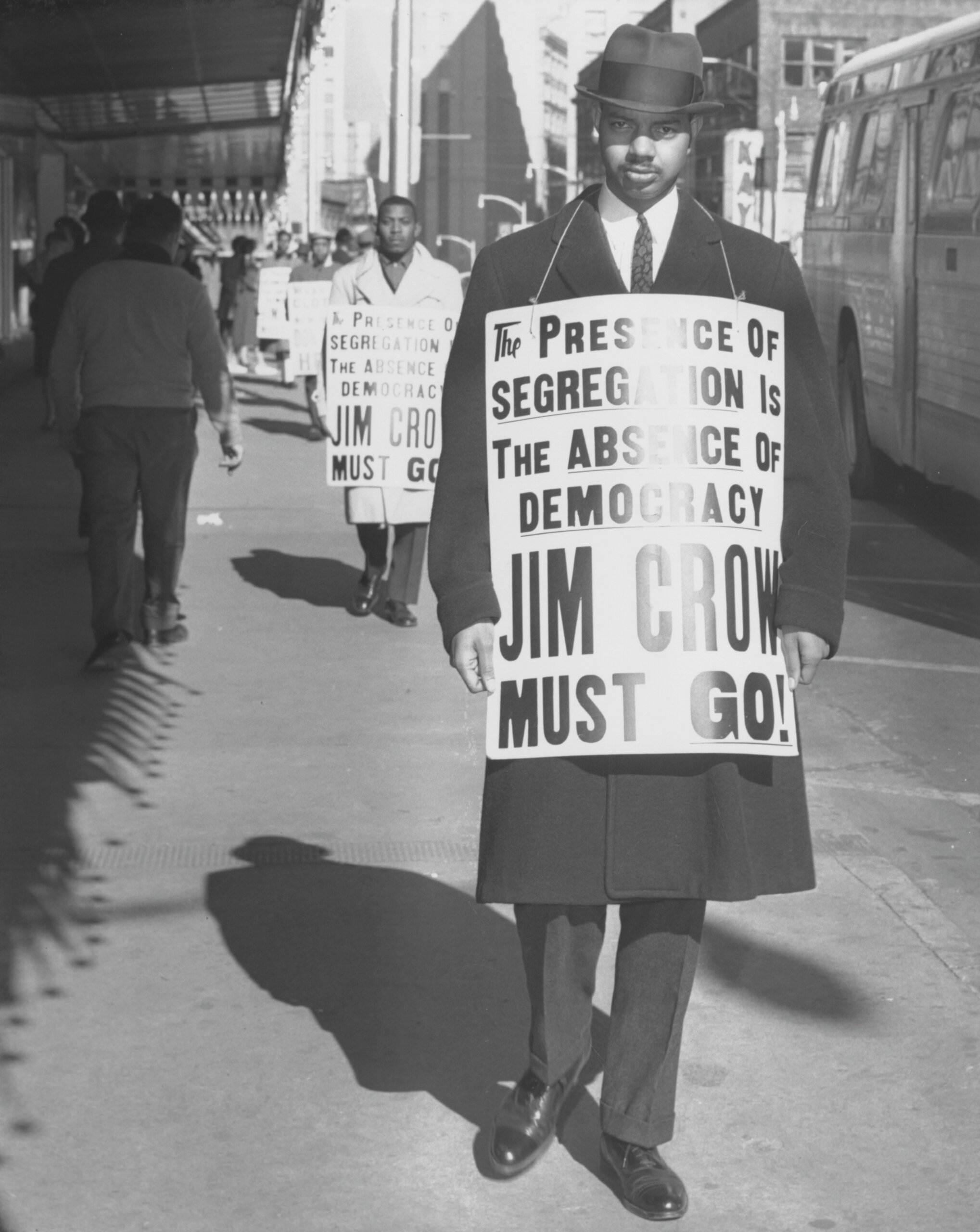
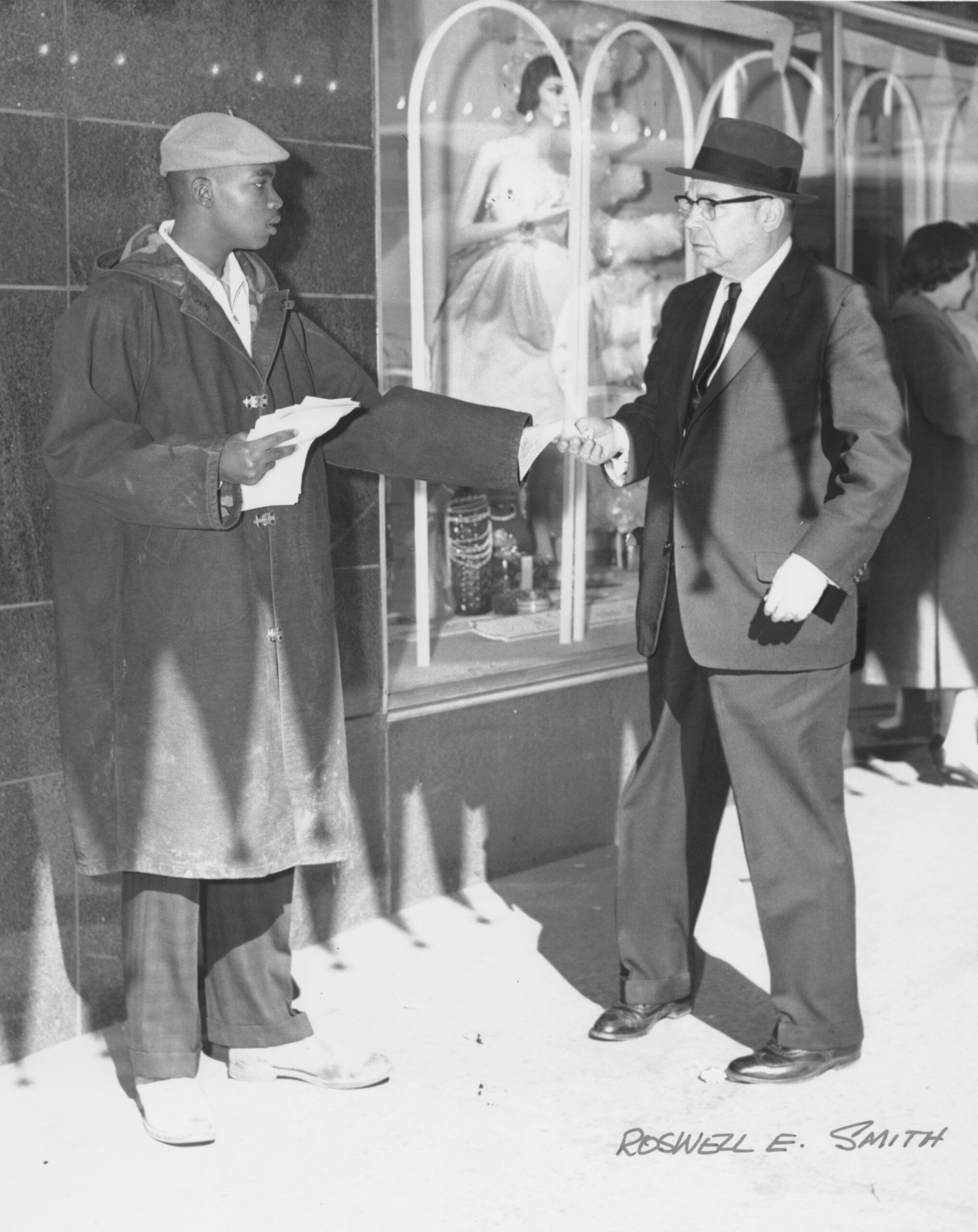
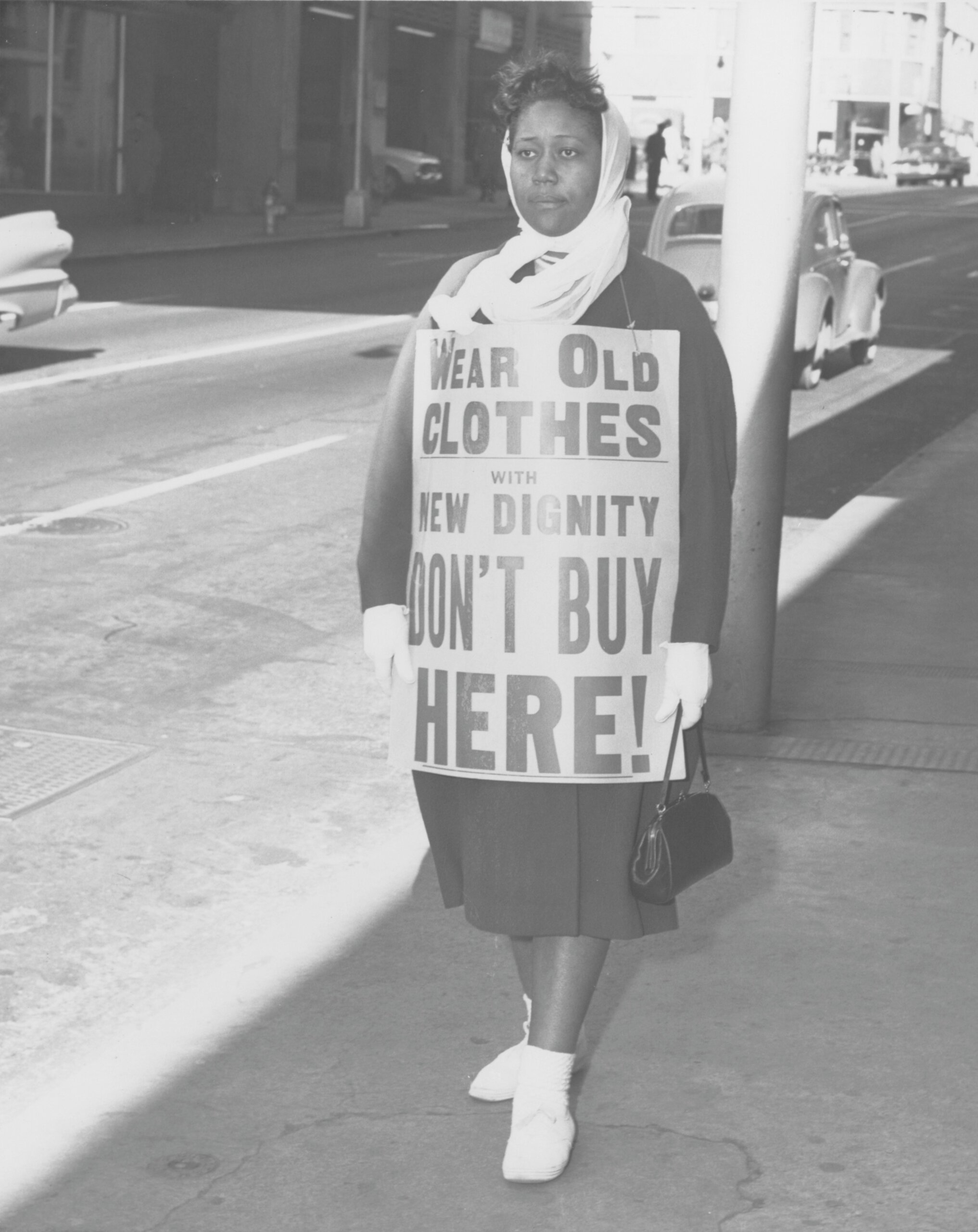
(15:29) Narrator: Black Atlanta was united behind the student-led boycott. People from different generations and occupations joined the picket lines.
Charles Black: Well after it was clear that the students had the support generally of the community, everybody wanted to walk then, all the preachers, all the everybody. And the folk who had done everything they could to stop it were out there marching, young and old.

(15:54) Narrator: Julia Bond, mother of student Julian:
Julia Bond: And they just didn't see how they could do without Rich's, but they joined the boycott. Afterwards, so many people who had gone to Rich's and spent so much money learned that it really wasn't necessary. They could do without some of those things.
Clarence Bacote: My wife was one of those who participated in the boycott. Of course, I must say I was a little selfish then. I didn't care how long they were parading around Rich's. It was saving me money!
Lonnie King: We got these people in Atlanta, Georgia to send us their Rich's charge cards. And we put them in safety deposit boxes at Rich's. Our slogan was, "Close down your account with segregation. Open up your account with freedom. Send us your charge card."
(16:48) Narrator: As the boycott moved into the spring of 1961, Atlanta's white power structure and the older Black leadership continued to negotiate. They focused on persuading the students to drop their demands until the city's potentially volatile school desegregation plan took place in the fall of 1961. At a transformative meeting they achieved their goal.
Lonnie King: It was an extremely emotional meeting, one in which I found people who were supposed to have been on my side, siding with the merchants. It was a very excruciating feeling.
(17:33) Narrator: Mayor Ivan Allen and the city's white business leadership leaned on the older Black leaders who in turn pressured student leader Lonnie King to accept the compromise.
Lonnie King: Anyway, I capitulated. As I look back in retrospect, that was probably one of the major decisions that I made that I'm ashamed of.
Narrator: Activist Benjamin Brown:
Benjamin Brown: Some of the students felt that Lonnie King, our head, our chairman, had sold them out. And they requested his resignation. So that was one of those real emotional moments in the whole movement. People crying and carrying on, you know.
Lonnie King: To wrap it all up, Ivan Allen went on television this same night and said that the lunch counters will open up again tomorrow. Segregated. The Negroes have agreed to wait and time it with the opening of schools. It became very clear that his job was to try and work out an agreement whereby from a PR point of view, it would appear as if the white folks gave us something as opposed to Black folks winning something. You follow me?
(18:52) Narrator: As word got out about the decision to call off the boycott in return for desegregated facilities in the fall, a mass meeting was arranged. Atlanta University professor Carl Holman and attorney Leroy Johnson remember the evening.
Carl Holman: And we'd had this big meeting at Warren Methodist Church at which point the Black negotiators found how deep the feeling was about having been betrayed. And we had to go through that evening with the hope that we would keep the Black community from tearing itself apart.

Leroy Johnson II: And the church was packed. And the students were there looking for blood. And we were there sitting on the platform, nervous, trying to make certain that we could appease the crowd in the sense of trying to get them to accept the agreement and they were saying, no, no, no and all hell broke loose.
Lonnie King: Oh, man. That meeting . . . About 2,000 people had gathered. An array of leaders tried to calm the crowd. And so Martin King's father got up, King, Sr., and he attempted to get them to calm down. He said that he devoted 30 years of his life to the civil rights movement in Atlanta, and, before he could go any further, this lady up in the stands said, "And that's what's wrong." And she proceeded to come down and she read the riot act to everybody there.
Julian Bond: I can remember this nurse, she was in her uniform, she was a nurse for Dr. Albert Davis, storming up the center of the church, saying, "You mean to tell me, you know, I tore up my credit card."
Lonnie King: Oh, God, the church went up. I mean you've seen these magical moments. The church went up. I mean they just, it was something. I felt sorry for King, because King had laid the groundwork in a lot of ways, but remember now these people are operating on incremental change. And all of a sudden here's revolutionary change.
Martin King by that time had eased in the back, Jr. And when they booed his daddy, he started crying. Tears started coming down. So finally, Martin said, "Let me talk."
Rev. Martin Luther King Jr.: We must honestly say to Atlanta that time is running out. If some concrete changes for good are not made soon, Negro leaders of this city will find it impossible to convince the masses of Negroes of the good faith of the negotiations presently taking place.
Leroy Johnson II: Martin Luther King Jr. came to the meeting and spoke to that crowd, and he said in essence that this agreement may not be all that we want, but it's an agreement we made, and I think we ought to accept it. And shift the burden to the white folks and let them break it. But his speech was so terrific, and I never thought anybody could have quelled that crowd.
Lonnie King: I've never heard a speech like that before or since. His march on Washington speech was nothing compared to that speech that night.
Rev. Martin Luther King Jr.: Atlanta needs an Amos to cry out, let justice roll down like waters and righteousness like a mighty stream. Atlanta needs another Jefferson to scratch across the pages of history words lifted to cosmic proportions: "We hold these truths to be self-evident that all men are created equal."
Leroy Johnson II: He stopped that crowd and the students then agreed to accept the agreement and that's what happened. But for Martin Luther King it never would have been accepted.


(23:07) Narrator: In the fall of 1961, Rich's Department Store and some other facilities, including the public schools, began to desegregate with a token number of Blacks. Although the coalition of students and community members held together, the power of the older Black leadership was broken. The new direct-action tactics continued through the mid-sixties forcing desegregation into the open.
As new leadership emerged, they too would discover the challenges of power—as the Atlanta style proved resilient once again. 
About the Creators
The audio documentary series Will the Circle Be Unbroken? was produced by the Southern Regional Council (SRC) and distributed by Public Radio International (PRI). George King served as producer, Steve Suitts as executive producer, and Worth Long and Randall Williams were senior associate producers. The series was narrated by Vertamae Smart-Grosvenor. The episode "Atlanta Student Movement" was written by Cliff Kuhn, Steve Suitts, and George King with Vertamae Smart-Grosvenor.
Trouble the Land is adapted and developed from the Will the Circle Be Unbroken? radio programs by the staff of Southern Spaces and the Emory Center for Digital Scholarship. Ella Myer serves as series editor. Audio and video editing by Steve Bransford. Additional editing by Allen Tullos, Angelica Johnson, Ayoung Kim, Nyaradzai Mahachi, and Jessica Halsey. Inquiries about the series can be directed to seditor@emory.edu.
Banner image: Student Nonviolent Coordinating Committee (SNCC) staff and supporters sit in at a Toddle House, Atlanta, Georgia, 1963. Photograph by Danny Lyon. Courtesy of Magnum Photos.©
Subscribe to our free newsletter to receive updates.
Recommended Resources
Archival Materials
To access a digitized selection of the unedited oral histories that the Southern Regional Council conducted and used as the foundation for the Atlanta episodes of Will the Circle Be Unbroken? visit the Southern Regional Council's collection in Emory University's Aviary database.
Will the Circle Be Unbroken's physical program files and sound recordings can be found in the Stuart A. Rose Manuscript, Archives, and Rare Book Library at Emory University.
Brown-Nagin, Tomiko. Courage to Dissent: Atlanta and the Long History of the Civil Rights Movement. Oxford University Press, 2012.
Grady-Willis, Winston A. Challenging U.S. Apartheid: Atlanta and Black Struggles for Human Rights, 1960-1977. Duke University Press, 2006.
Lefever, Harry G., and Michael C. Page. Sacred Places: A Guide to the Civil Rights Sites in Atlanta, Georgia. Illustrated edition. Mercer University Press, 2008.
Sims-Alvarado, Karcheik. Atlanta and the Civil Rights Movement: 1944-1968. Arcadia Publishing, 2017.
Tuck, Stephen G. N. Beyond Atlanta: The Struggle for Racial Equality in Georgia, 1940-1980. University of Georgia Press, 2003.
Web
Atlanta History Center. “The Color-Line: Problem of the Centuries.” Accessed March 28, 2025. https://www.atlantahistorycenter.com/exhibitions/the-color-line-the-problem-of-the-centuries/.
Atlanta University Center. “Seeking to Tell a Story: Political Action from Slavery to Civil Rights.” Accessed September 23, 2025. https://digitalexhibits.auctr.edu/exhibits/show/seekingtotell/overview.
Digital SNCC Gateway. “Atlanta Student Movement.” Accessed September 23, 2025. https://snccdigital.org/inside-sncc/establishing-sncc/campus-affiliates/atlanta-student-movement/.
.jpg)